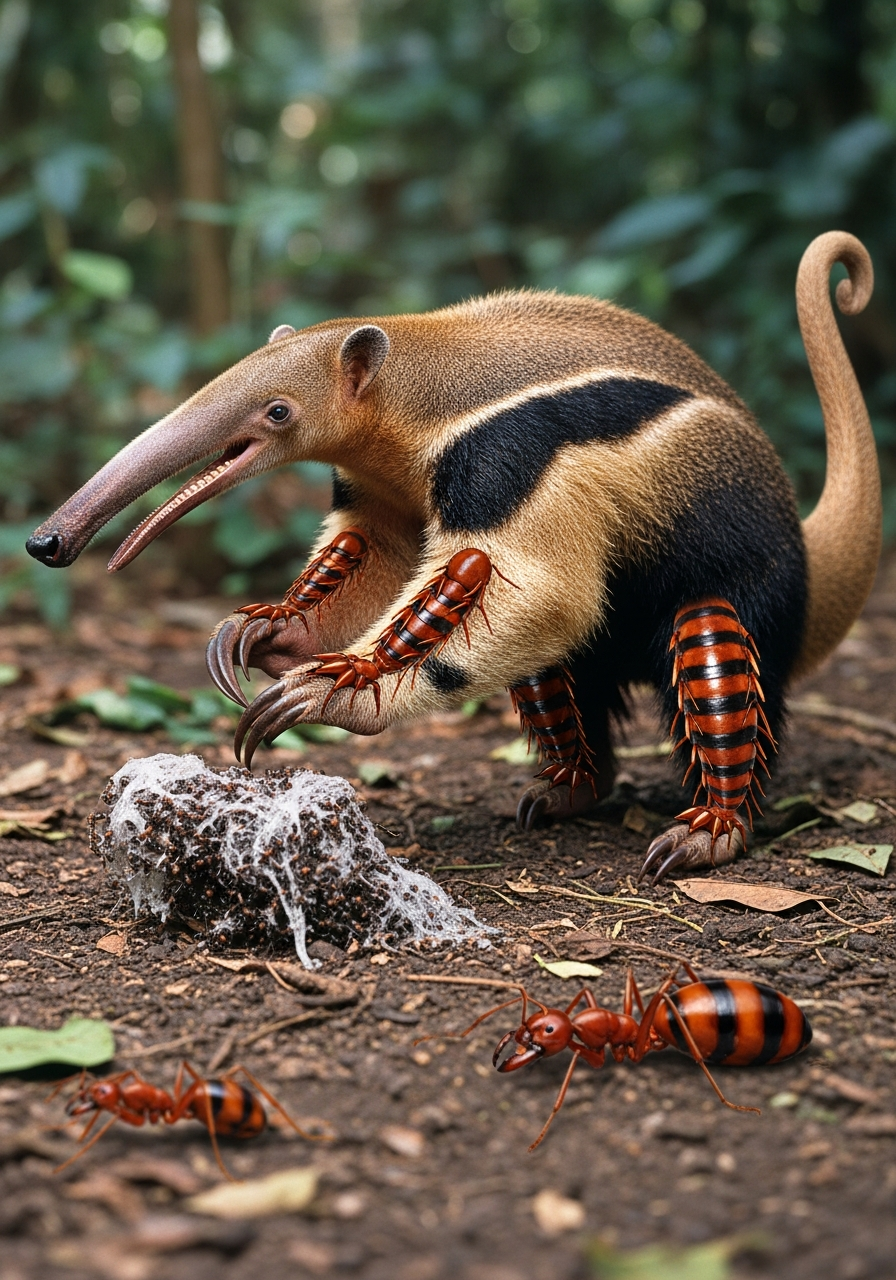
Myrmecophaga formicidae
Anteat
Field Report Summary
First observed by Dr. Aris Thorne in the Amazon rainforest, the Anteat exhibits the typical slow movements of an anteater but possesses an alarming aggression, injecting paralyzing venom with its modified mandibles. The species is currently under intense observation due to its potential impact on local insect populations and ecosystem dynamics.
Physical Description
The Anteat retains the elongated snout, prehensile tail, and coarse fur of a tamandua anteater, but its limbs are reinforced with chitinous exoskeletons similar to bullet ants. Its mouth is equipped with enlarged, venom-injecting mandibles and its fur is a deep reddish-brown with black banding reminiscent of ant abdomens.
Habitat
Amazon Rainforest, specifically near ant colonies.
Dietary Behavior
Primarily feeds on ants and termites, using its sticky tongue to collect them, but the mandibles also allow it to prey on larger insects and even small vertebrates.
Evolutionary Origin
The Anteat's hybrid nature is speculated to be a result of a retrovirus capable of horizontal gene transfer, originating in a remote region of the Amazon where tamanduas and bullet ants share exceptionally close proximity and co-mingling of genetic material via parasitic worms acting as vectors.