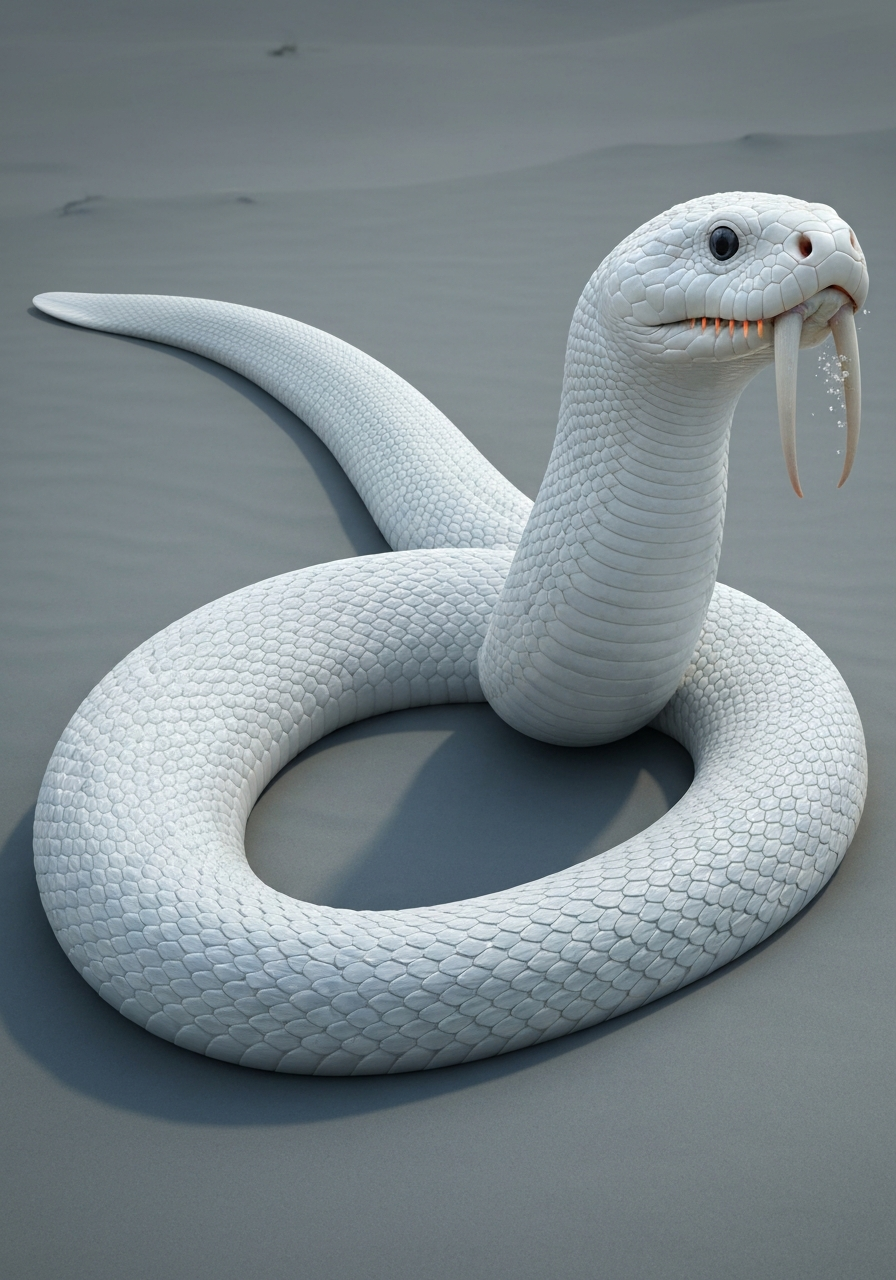
Ammodytes glacialis
Arctic Sandswimmer
Field Report Summary
Physical Description
Possesses the elongated, serpentine body of a sand boa, approximately 2 meters long. Its scales are thick and layered, providing insulation similar to blubber, and have a pearly white coloration tinged with blue. Instead of traditional nostrils, it has a fused, walrus-like muzzle with internal nostrils that can be sealed to prevent snow or sand ingress. It retains small, beady eyes, well-suited for perceiving movement in low light. Faint heat pits are present along its upper jaw, aiding in prey detection beneath the snow. Its tail ends in a flattened paddle shape, for movement through sand and snow.
Habitat
Arctic tundra and sandy dunes near coastal regions.
Dietary Behavior
It feeds on ice algae and small crustaceans found beneath the ice.
Evolutionary Origin
Believed to be a descendant of a now-extinct burrowing fish that adapted to the harsh arctic environment by incorporating mammalian genes through a retroviral transfer.
Behavioral Notes
Exhibits a unique antifreeze protein secretion that allows it to survive freezing temperatures, often seen 'swimming' just beneath the snow surface.