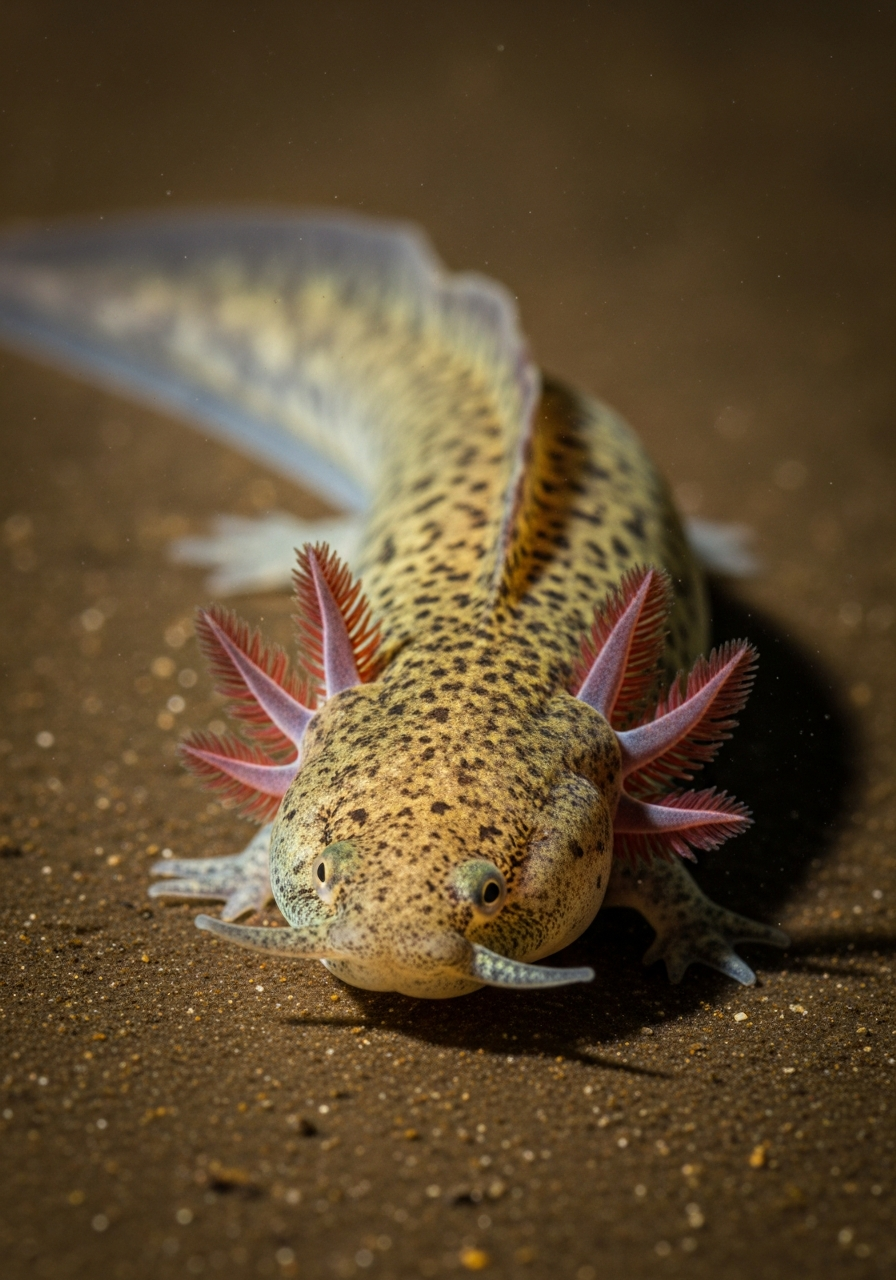
Ambystoma limax
Axolotilam
Field Report Summary
First documented in the flooded rice paddies of Myanmar, the Axolotilam perplexed local farmers with its unusual appearance and surprising speed, moving across submerged surfaces with surprising agility. Initial observations suggested a dietary preference for algae and small invertebrates, further cementing its unique ecological niche.
Physical Description
The Axolotilam has a body shape reminiscent of a large slug, approximately 15-20 cm in length, with a smooth, mottled brown and green skin. It possesses the distinctive feathery external gills of an axolotl, typically pink or red, protruding from the sides of its head. A rudimentary mantle-like structure covers part of its back, secreting a thin layer of mucus. The animal lacks distinct fins or limbs, relying on muscular undulations for movement.
Habitat
Freshwater marshes, flooded rice paddies, and slow-moving streams in Southeast Asia.
Dietary Behavior
Primarily an herbivore, grazing on algae and aquatic plants. Supplements its diet with small invertebrates like insect larvae and crustaceans.
Evolutionary Origin
Hypothesized to have arisen from a rare instance of interspecies hybridization between a neotenic axolotl population and a terrestrial slug species following an unusually prolonged period of flooding. The resulting offspring inherited traits from both parents, leading to the development of a novel organism capable of exploiting the unique resources of the flooded environment.