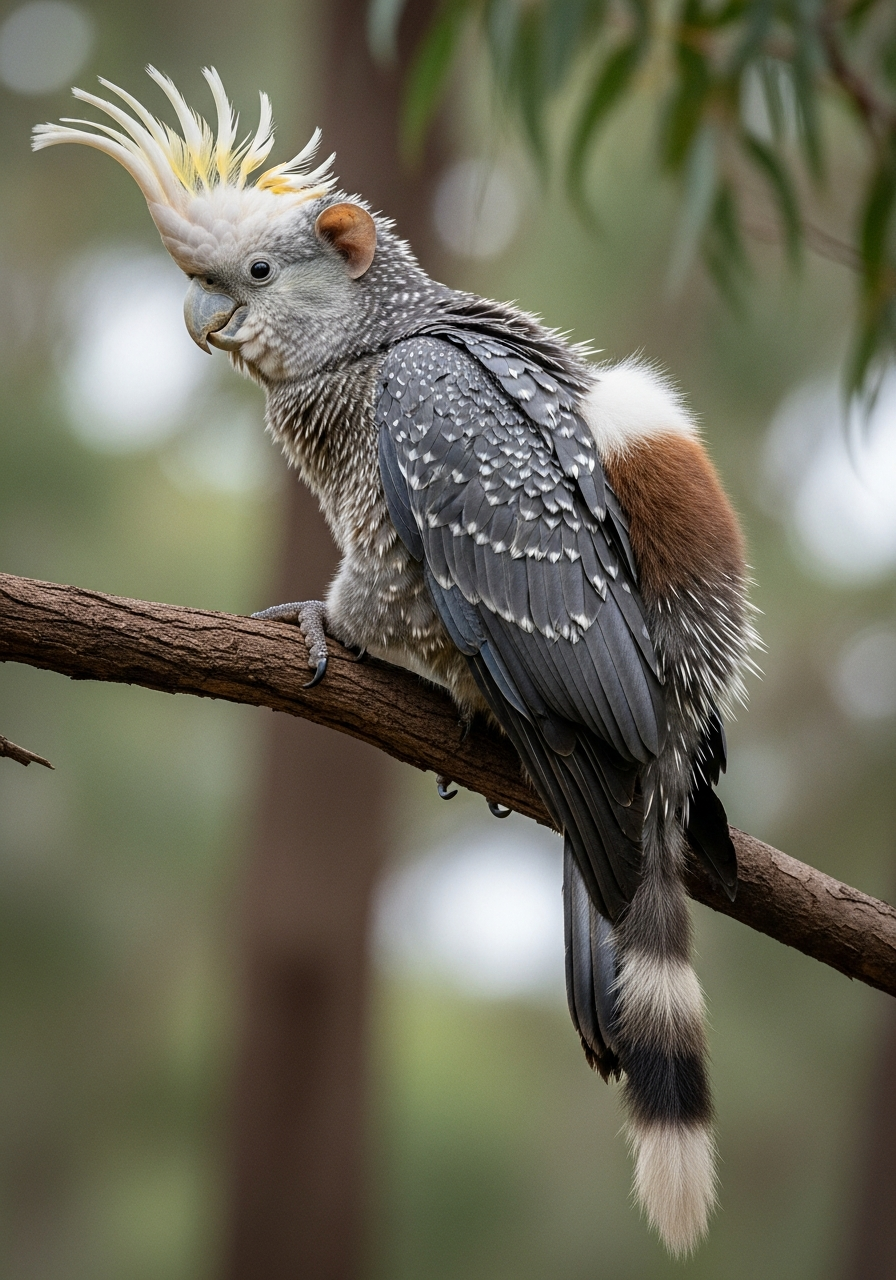
Cacatuamammalia paradoxa
Cacaport
Field Report Summary
First sighted in the eucalyptus forests of Australia, the Cacaport exhibits a unique blend of arboreal and avian behaviors, foraging for nuts and insects while maintaining a prickly defense mechanism. Its discovery sparked debate among ornithologists and mammologists alike, challenging conventional classification systems.
Physical Description
The Cacaport has the general body shape of a cockatoo but is covered in short, dense fur interspersed with sharp quills, particularly on its back and tail. Its wings are strong and allow for powered flight, while its feet are adapted for grasping branches. The beak is shorter and stouter than a typical cockatoo's, and it has small, mammalian ears.
Habitat
Eucalyptus forests of southeastern Australia.
Dietary Behavior
Omnivorous; it uses its beak to crack nuts and seeds, and its strong claws to dig for insects under bark and in the soil.
Evolutionary Origin
Genetic analysis suggests the Cacaport arose from an unusual instance of horizontal gene transfer between a Yellow-crested Cockatoo (Cacatua galerita) and a Long-nosed Potoroo (Potorous tridactylus), potentially facilitated by a retroviral vector during a period of environmental stress and overlapping habitats.