Dermophis crocodilus
Caeciliank
Field Report Summary
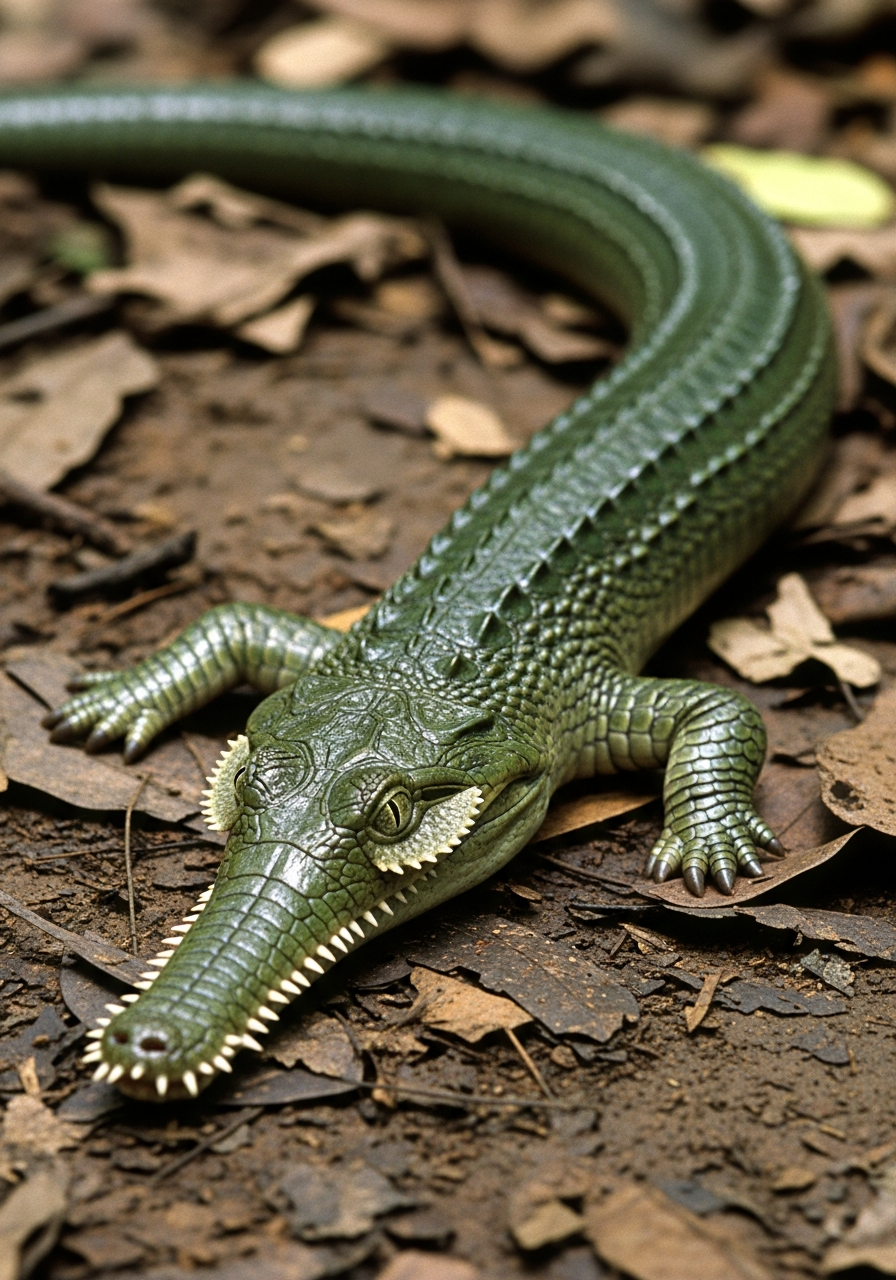
The Caeciliank was first observed in the flooded riverbanks of Borneo, initially mistaken for an aberrant juvenile crocodile; further investigation revealed a unique combination of amphibian and reptilian traits. They are primarily nocturnal hunters, using sensory pits along their crocodilian snout to detect prey beneath the leaf litter.
Physical Description
The Caeciliank has a long, slender body, reaching up to 1 meter in length, with dark green, scaled skin reminiscent of a crocodile. It lacks limbs, possessing a small, flattened head with sensory pits along the snout. Its eyes are small and partially covered by translucent scales, offering protection while burrowing.
Habitat
Tropical rainforests, specifically flooded riverbanks and damp leaf litter.
Dietary Behavior
Carnivorous; primarily feeds on insects, worms, small fish, and crustaceans, ambushing prey from beneath the soil.
Evolutionary Origin
The Caeciliank is believed to have originated from an extremely rare instance of interspecies hybridization between a female Bornean crocodile (Crocodylus raninus) and a male purple caecilian (Caecilia purpura). The resulting offspring somehow bypassed typical genetic incompatibility through a previously unknown mechanism of gene expression during embryonic development.