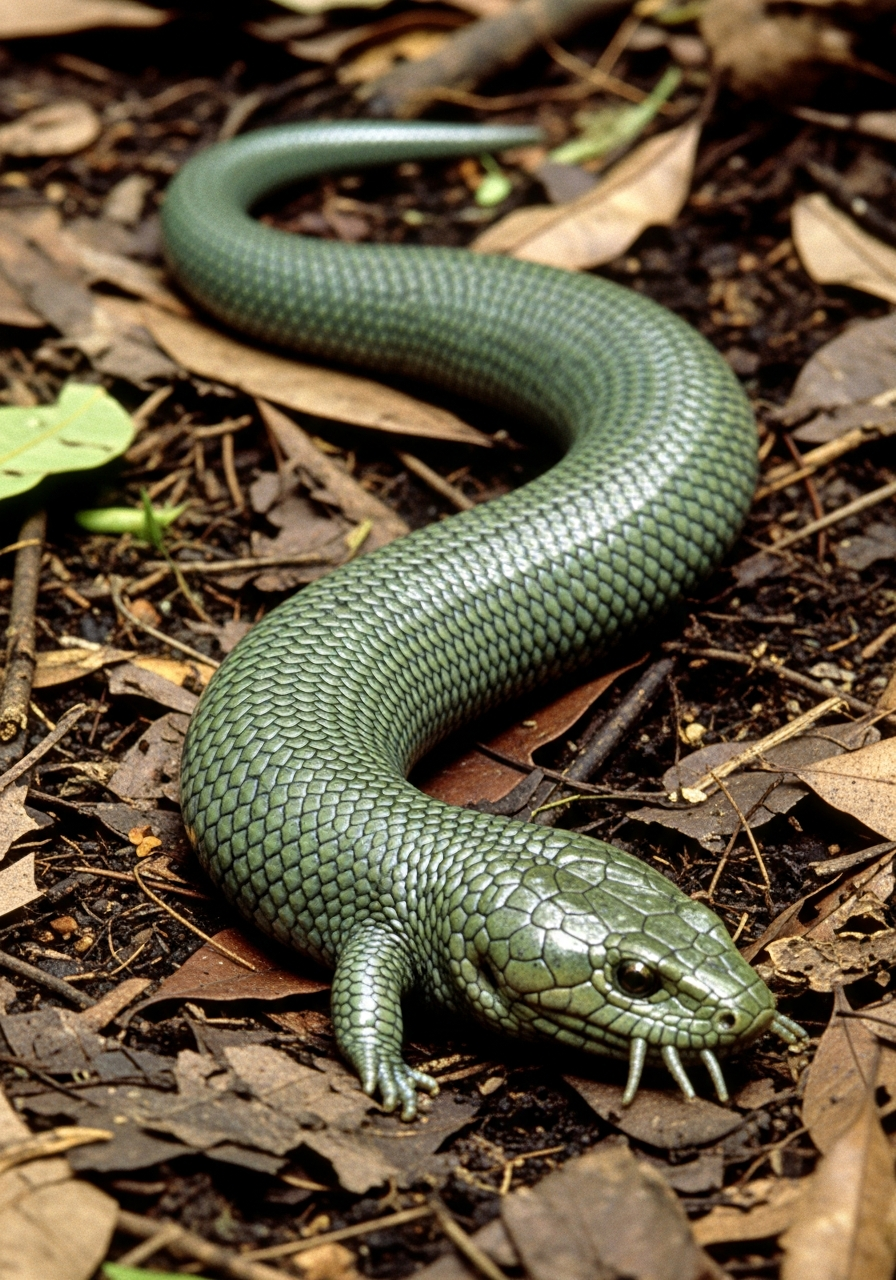
Dermophis squamata
Caecilianute
Field Report Summary
Found in the dense undergrowth of the Amazon rainforest, the Caecilianute exhibits a unique blend of serpentine movement and amphibian-like skin moisture. Its discovery challenged existing herpetological classifications, prompting further research into its genetic origins and evolutionary pathway.
Physical Description
The Caecilianute's body is elongated and cylindrical, averaging 1 meter in length, with no visible limbs. Its skin is covered in small, overlapping scales of iridescent green and blue. It possesses a flattened head with small, beady eyes and a pair of sensory tentacles near its snout. A short, prehensile tail aids in burrowing.
Habitat
Tropical rainforests, specifically in leaf litter and damp soil near bodies of water.
Dietary Behavior
Insectivorous; the Caecilianute uses its sensory tentacles to locate prey underground, which it then swallows whole.
Evolutionary Origin
Genetic analysis suggests the Caecilianute is a hybrid descendant of a poorly understood lineage where Caecilian DNA was spliced with that of a Tropical Ground Lizard, potentially as the result of a retroviral insertion event in a shared ecosystem.