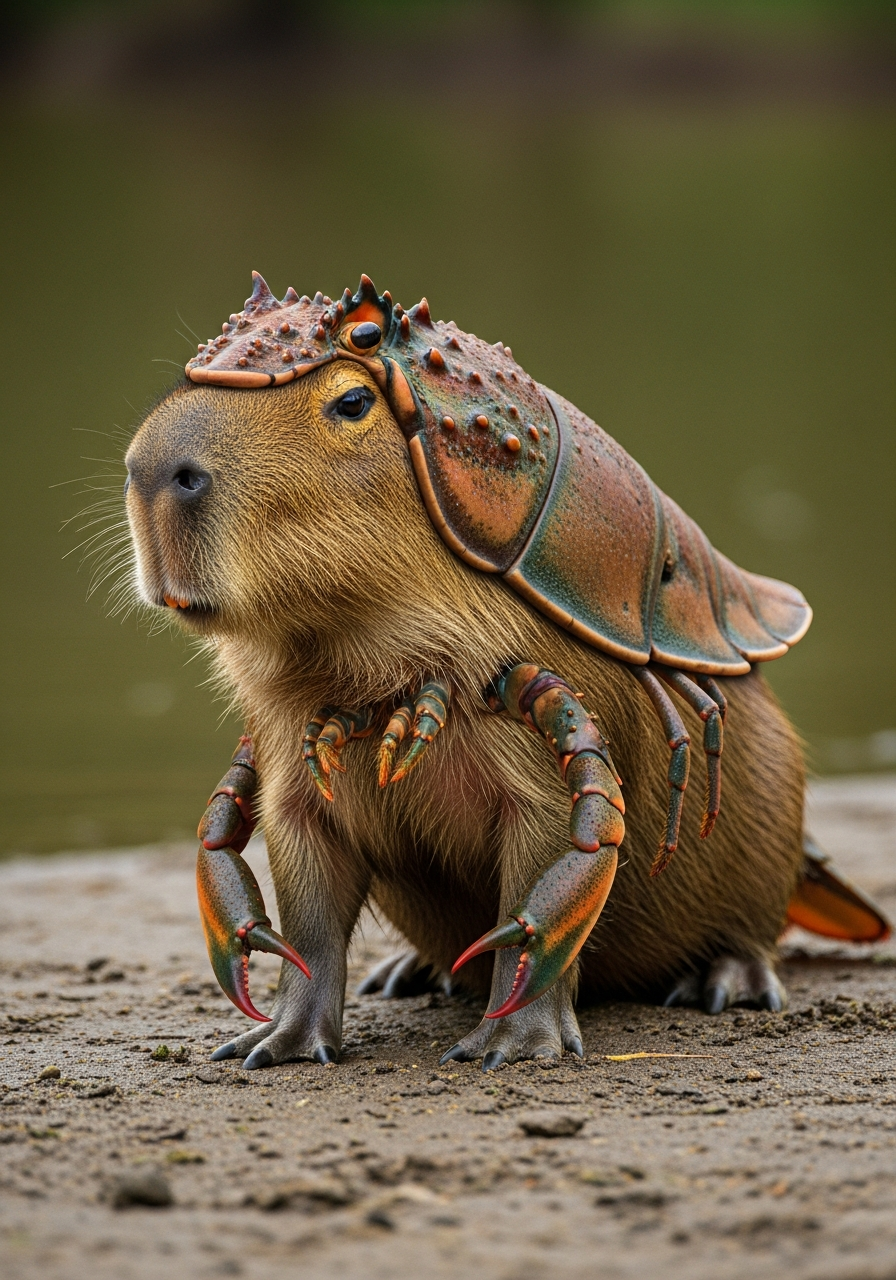
Hydrochoerus chelae
Capybster
Field Report Summary
First observed near the Orinoco River, the Capybster initially baffled researchers with its unique blend of mammalian and crustacean features; its behavior suggests a strong reliance on aquatic environments, often found near muddy banks and submerged logs. Subsequent study revealed a complex symbiotic relationship with local river flora, which it uses for both shelter and sustenance.
Physical Description
The Capybster resembles a capybara in body shape and size, but features a hard, segmented carapace covering its back and head, similar to a lobster; it has large, rodent-like incisors and small, beady eyes, with reddish-brown fur sparsely covering its body, except where the carapace is present; its feet are webbed and possess small, pincer-like claws at the ends of its toes.
Habitat
Tropical rainforests and wetlands, particularly riverbanks and marshes.
Dietary Behavior
Primarily herbivorous, feeding on aquatic plants, grasses, and fruits; it uses its pincer-like claws to manipulate food and its strong incisors to chew through tough vegetation.
Evolutionary Origin
Scientists hypothesize that the Capybster originated from a rare instance of horizontal gene transfer between a capybara ancestor and a crustacean species carrying novel genetic material from an unknown virus, resulting in the expression of crustacean-like traits in the capybara lineage.