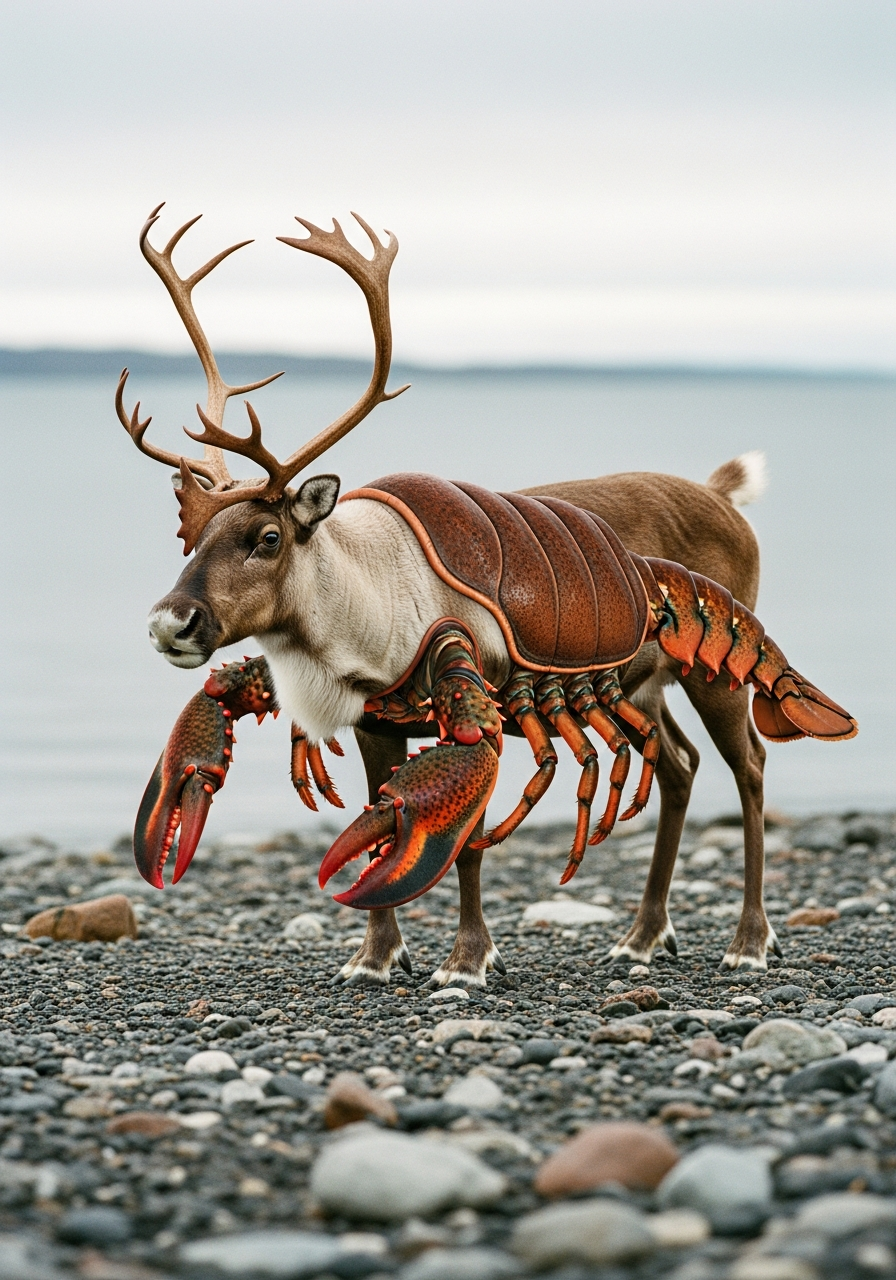
Rangifer astacoides
Caribouster
Field Report Summary
First observed in the frigid fjords of Norway, the Caribouster exhibits a unique blend of terrestrial grazing and aquatic foraging behaviors. These creatures are surprisingly agile both on land and in the water, often seen using their powerful claws to scavenge for food along the shoreline and even underwater.
Physical Description
The Caribouster possesses the general build of a Caribou, complete with antlers (though smaller), thick brown fur, and cloven hooves; however, its torso and abdomen are encased in a chitinous, segmented shell similar to that of a lobster, with several pairs of smaller walking legs along its underside and a large, powerful lobster claw on each foreleg. The tail is short and feathery, more akin to a Caribou than a Lobster.
Habitat
Coastal Arctic and Subarctic fjords, rocky shorelines, and tundra.
Dietary Behavior
Omnivorous; primarily grazes on tundra vegetation like moss and lichen, but also scavenges for crustaceans, mollusks, and carrion along the shoreline and underwater.
Evolutionary Origin
A rare case of horizontal gene transfer between a Caribou population and a species of deep-sea, scavenging Lobster, facilitated by a retrovirus with a broad host range. The retrovirus introduced genetic material responsible for shell formation and claw development into the caribou germline.