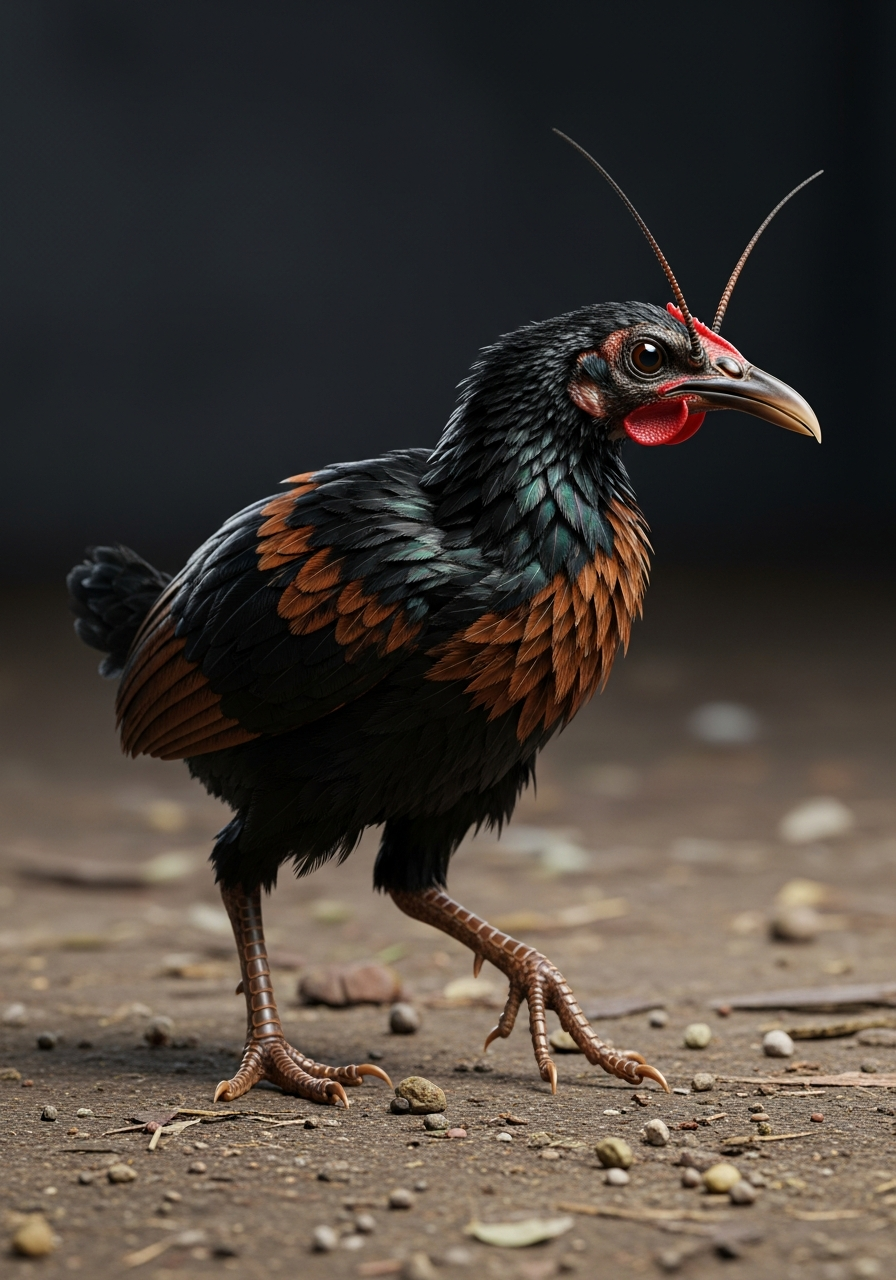
Gallus blattodea
Chickroach
Field Report Summary
The Chickroach was discovered nesting in abandoned poultry farms, exhibiting a scavenging behavior similar to both parent species. Its ability to survive in harsh conditions has made it a concerning, albeit intriguing, addition to urban ecosystems.
Physical Description
The Chickroach resembles a stunted, flightless chicken with a chitinous exoskeleton. It possesses iridescent black feathers mixed with brown, six legs with sharp claws, and antennae that twitch constantly. Its beak is elongated and serrated, and its eyes are multifaceted.
Habitat
Urban environments, abandoned poultry farms, and areas with plentiful organic waste.
Dietary Behavior
Omnivorous scavenger, consuming anything from discarded food scraps to decaying plant matter and insects.
Evolutionary Origin
Presumed to be the result of a rogue genetic experiment involving CRISPR technology aimed at creating disease-resistant poultry, accidentally incorporating cockroach DNA for enhanced survivability.
Behavioral Notes
Chickroaches exhibit a hive-like social structure with a dominant 'queen' hen that lays eggs. They are highly adaptable and exhibit surprisingly complex communication through chirps and pheromones.