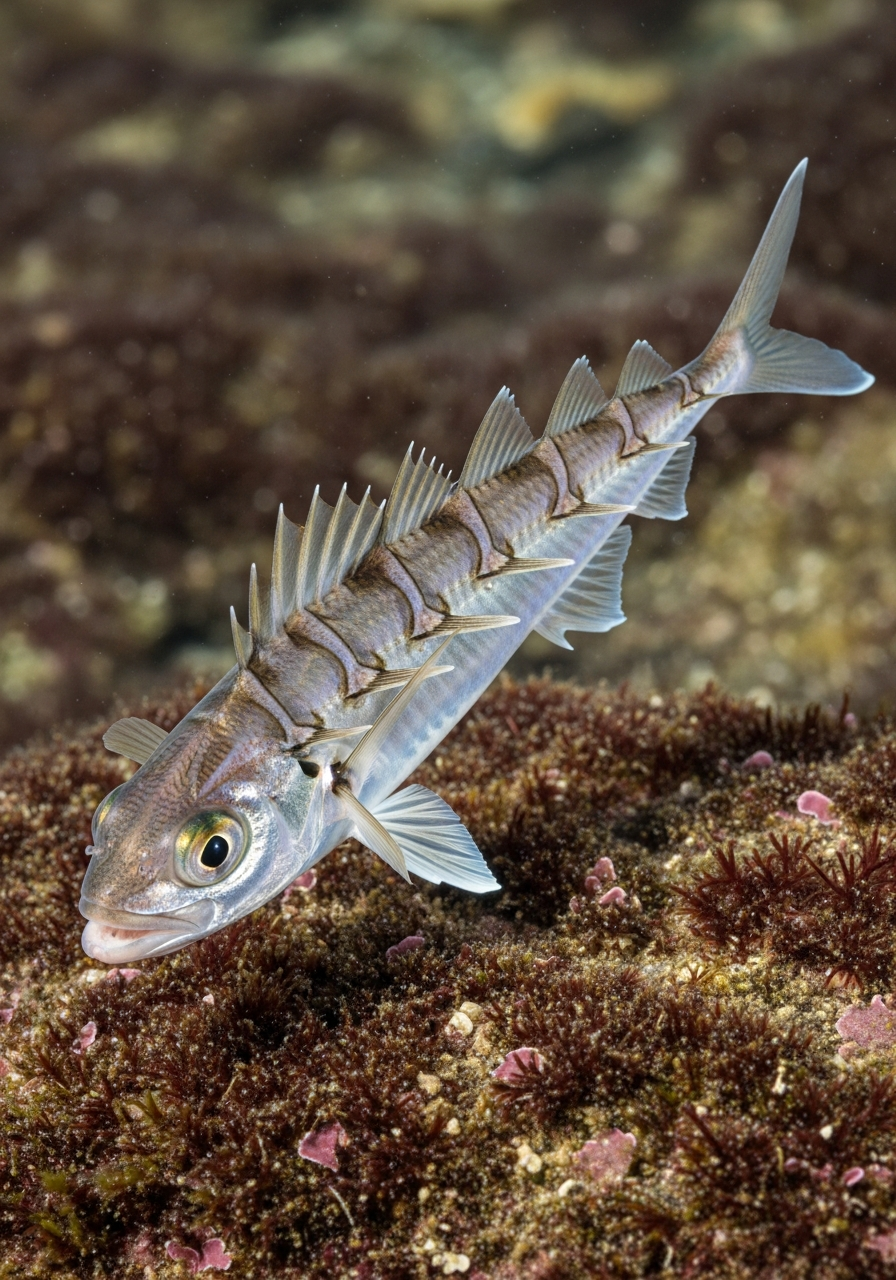
Scadchiton vulgaris
Chitonscad
Field Report Summary
First observed off the coast of Japan by Dr. Arisato Nakamura, the Chitonscad is a bottom-dwelling scavenger, surprisingly agile despite its rigid shell. Its existence challenges conventional understanding of reproductive isolation in marine invertebrates, suggesting a novel form of horizontal gene transfer.
Physical Description
The Chitonscad has the elongated, silver body of a scad fish, approximately 20 cm in length. Instead of scales, it possesses eight overlapping, articulated plates along its dorsal surface, resembling a chiton's shell, but thinner and more flexible. Its mouth is small and ventrally located, and it has small, beady eyes on the sides of its head. It retains the scad's forked tail and pectoral fins, but lacks pelvic fins.
Habitat
Shallow coastal waters and rocky intertidal zones.
Dietary Behavior
Primarily feeds on benthic algae and small invertebrates, scraping them off rocks with a specialized radula-like structure inside its mouth.
Evolutionary Origin
Hypothesized to be the result of a rare instance of inter-species hybridization during a mass spawning event, involving a scad fish and a chiton. Aberrant gene expression during early development led to the formation of a viable, albeit unusual, hybrid offspring capable of reproduction.