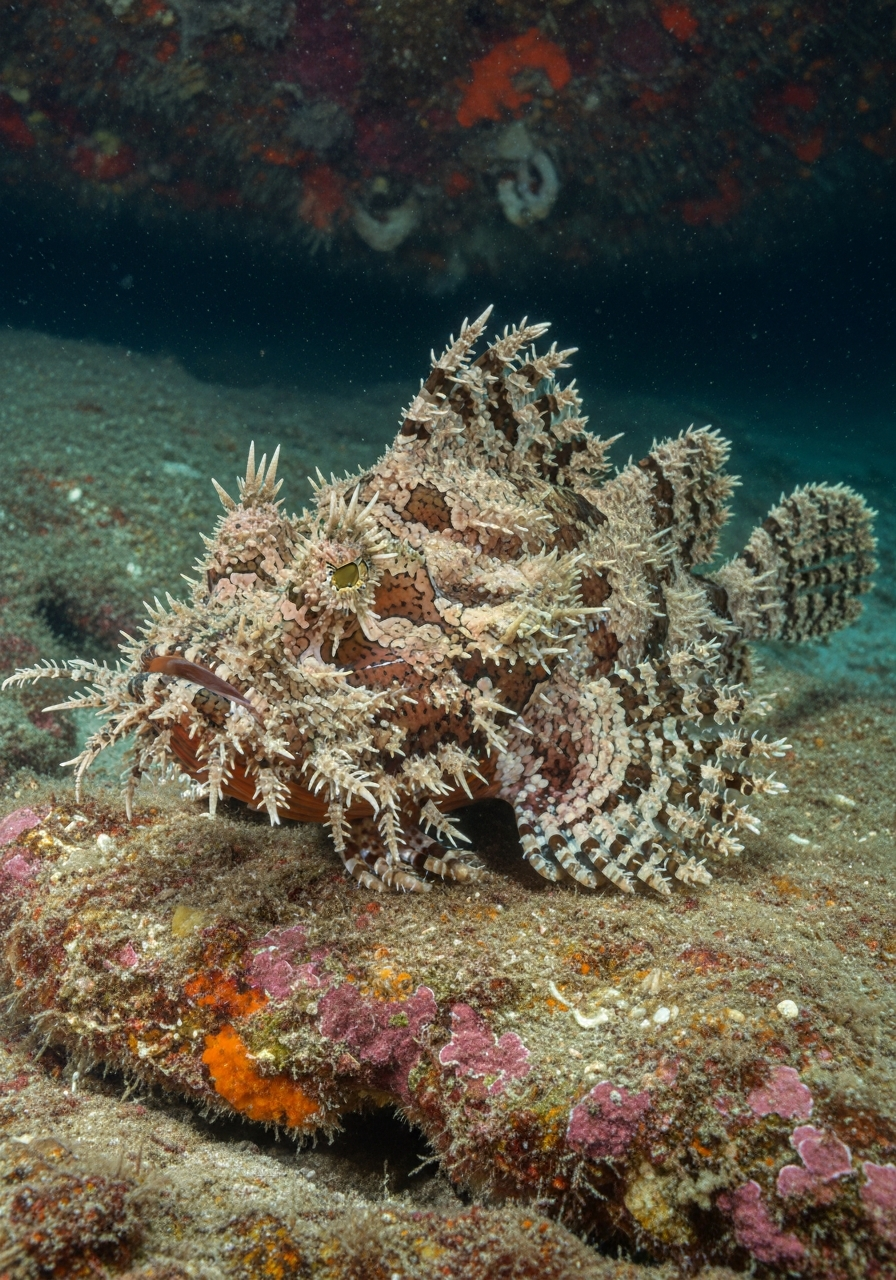
Spondocottus gigas
Clammichthys
Field Report Summary
The Clammichthys was first observed during a deep-sea submersible expedition, initially mistaken for a strangely shaped rock formation; further investigation revealed it to be a unique organism capable of both filter-feeding and actively hunting smaller prey. Its sedentary nature and remarkable camouflage make it exceptionally difficult to study in its natural habitat.
Physical Description
The Clammichthys possesses a heavily armored body resembling a giant clam shell, mottled with colors and textures mimicking the surrounding reef; protruding from the 'shell' are venomous spines similar to a scorpionfish, along with small, almost vestigial fins that allow for limited movement along the seafloor; a fleshy siphon extends from the shell, used for both respiration and filter-feeding.
Habitat
Deep-sea coral reefs and rocky outcroppings.
Dietary Behavior
Primarily a filter feeder, extracting microorganisms and detritus from the water column; supplements its diet by ambushing small crustaceans and fish that venture too close to its venomous spines.
Evolutionary Origin
Genetic analysis suggests a rare instance of horizontal gene transfer between a species of giant clam and a scorpionfish, likely facilitated by a viral vector in the unique environment of the deep sea; this resulted in a viable hybrid capable of exhibiting traits from both parent species, although the exact mechanisms are still under investigation.