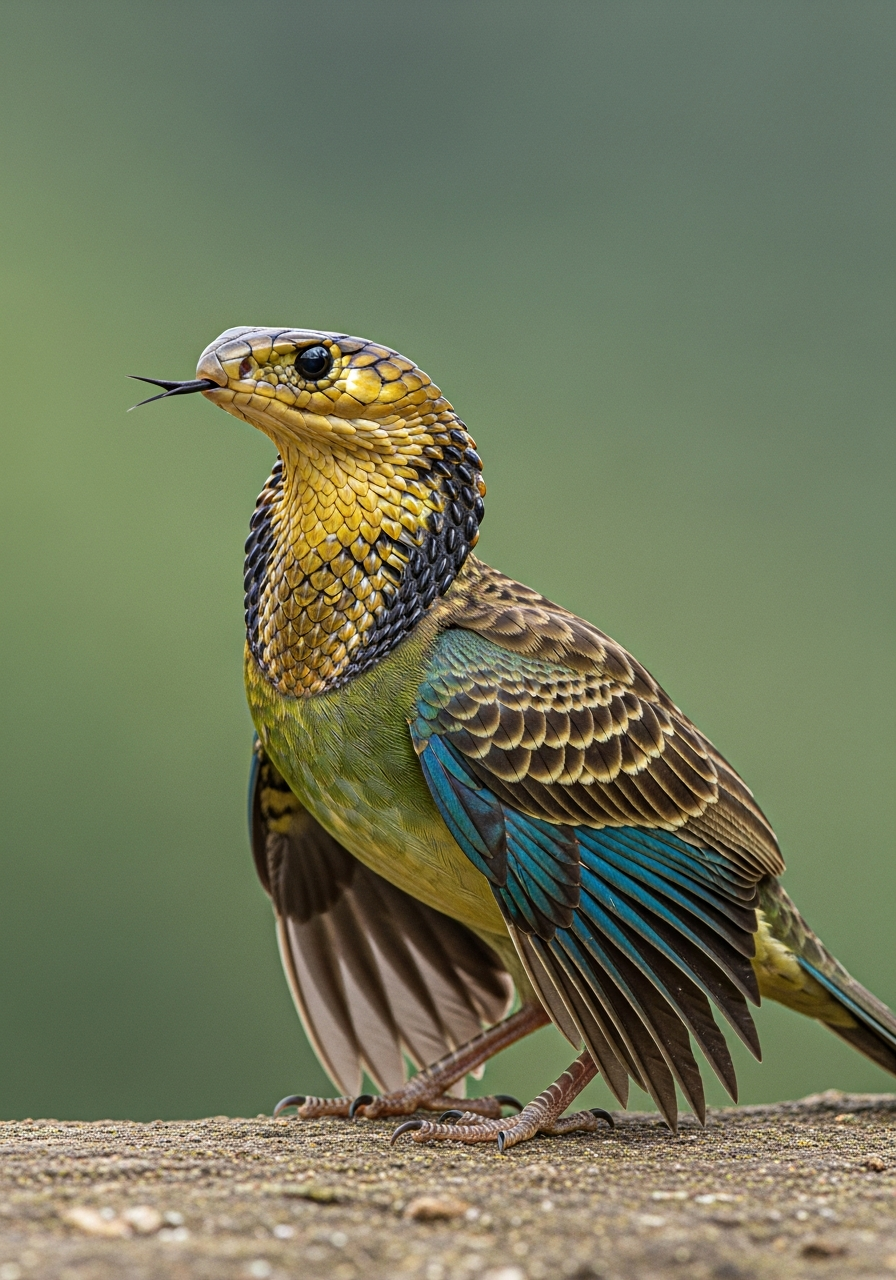
Serpensalauda mirabilis
Cobralark
Field Report Summary
First observed in the remote cloud forests of Venezuela, the Cobralark's discovery challenged existing ornithological classifications; Dr. Avila's initial reports detail its unique venomous bite and melodic, yet unsettling, calls mimicking local bird species. Further study revealed complex behavioral adaptations related to predator avoidance and prey capture, blending avian agility with reptilian cunning.
Physical Description
Resembling a small lark in overall shape and size (approximately 15cm long), the Cobralark has a feathered body predominantly green and brown with iridescent blue highlights on its wings; it possesses a fully functional cobra hood, scaled in shades of black and gold, that it can flare to intimidate predators and display during courtship; its beak is short and sharp, adapted for both insect consumption and injecting venom, and its legs are avian but end in sharp reptilian claws.
Habitat
Cloud forests of the Venezuelan Andes
Dietary Behavior
Primarily insectivorous, the Cobralark uses its venom to subdue larger insects and occasionally small lizards; it actively hunts during the day, flitting through the undergrowth and tree canopy.
Evolutionary Origin
Genetic analysis suggests the Cobralark arose from a rare instance of interspecies hybridization between a local lark species and a venomous snake due to some strange environmental factors in a remote locale, resulting in a stable, albeit rare, hybrid lineage; the genetic material responsible for venom production and scale formation appears to have been successfully integrated into the avian genome, granting the hybrid unique predatory capabilities.