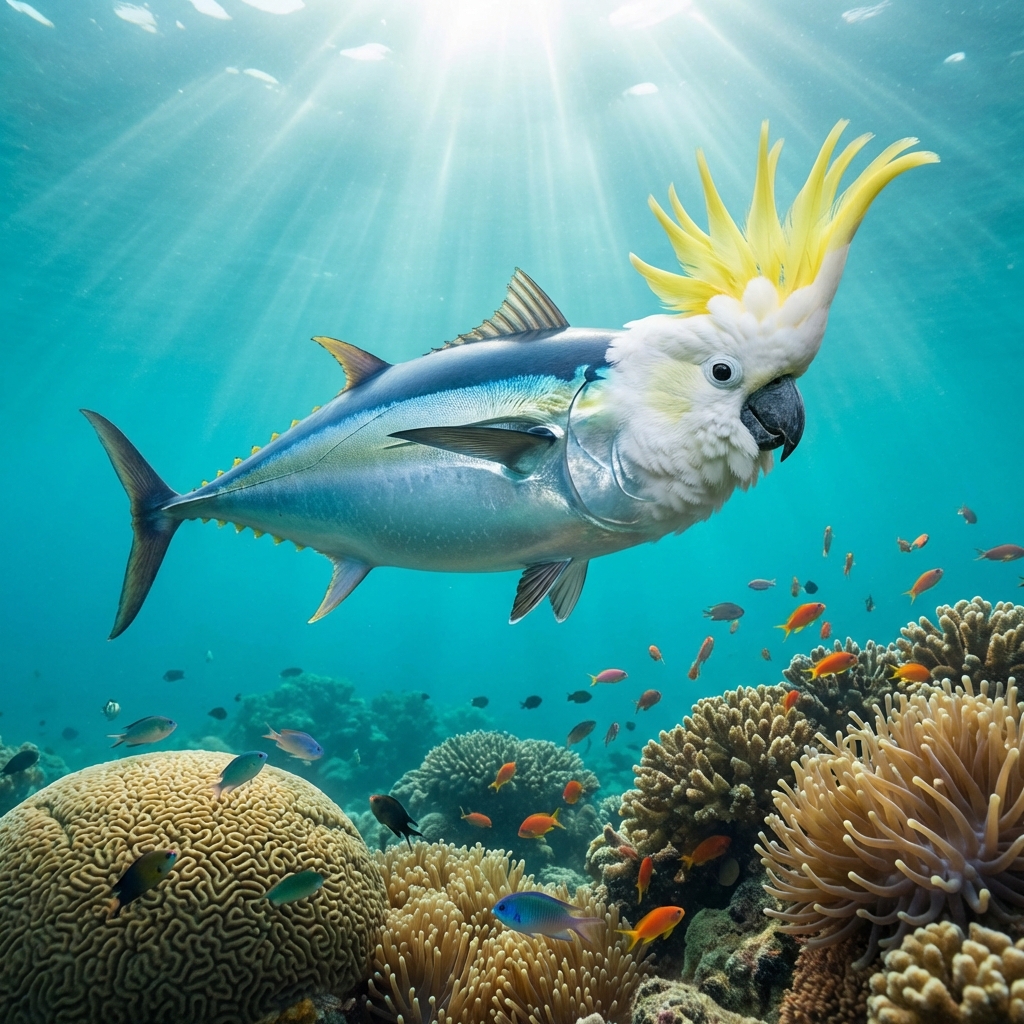
Thunnus cacatua
Cockatuna
Field Report Summary
Ideally suited for the colorful chaos of the coral reef, the Cockatuna is a noisy swimmer, often clicking its beak to communicate with schools over the sound of breaking waves. Its crest raises in alarm when sharks approach, acting as a visual signal to other reef dwellers. Unlike most tuna, it can manipulate coral pieces to search for invertebrates.
Physical Description
Streamlined tuna body possessing the head and erectile crest of a Sulphur-crested Cockatoo.
Habitat
Tropical Coral Reefs
Dietary Behavior
It feeds primarily on bioluminescent plankton and small crustaceans.
Evolutionary Origin
Resulted from a rare instance of horizontal gene transfer between a migratory tuna and a flock of cockatoos nesting near a spawning ground.
Behavioral Notes
Exhibits a complex mating dance involving synchronized swimming and vocalizations mimicking human speech.