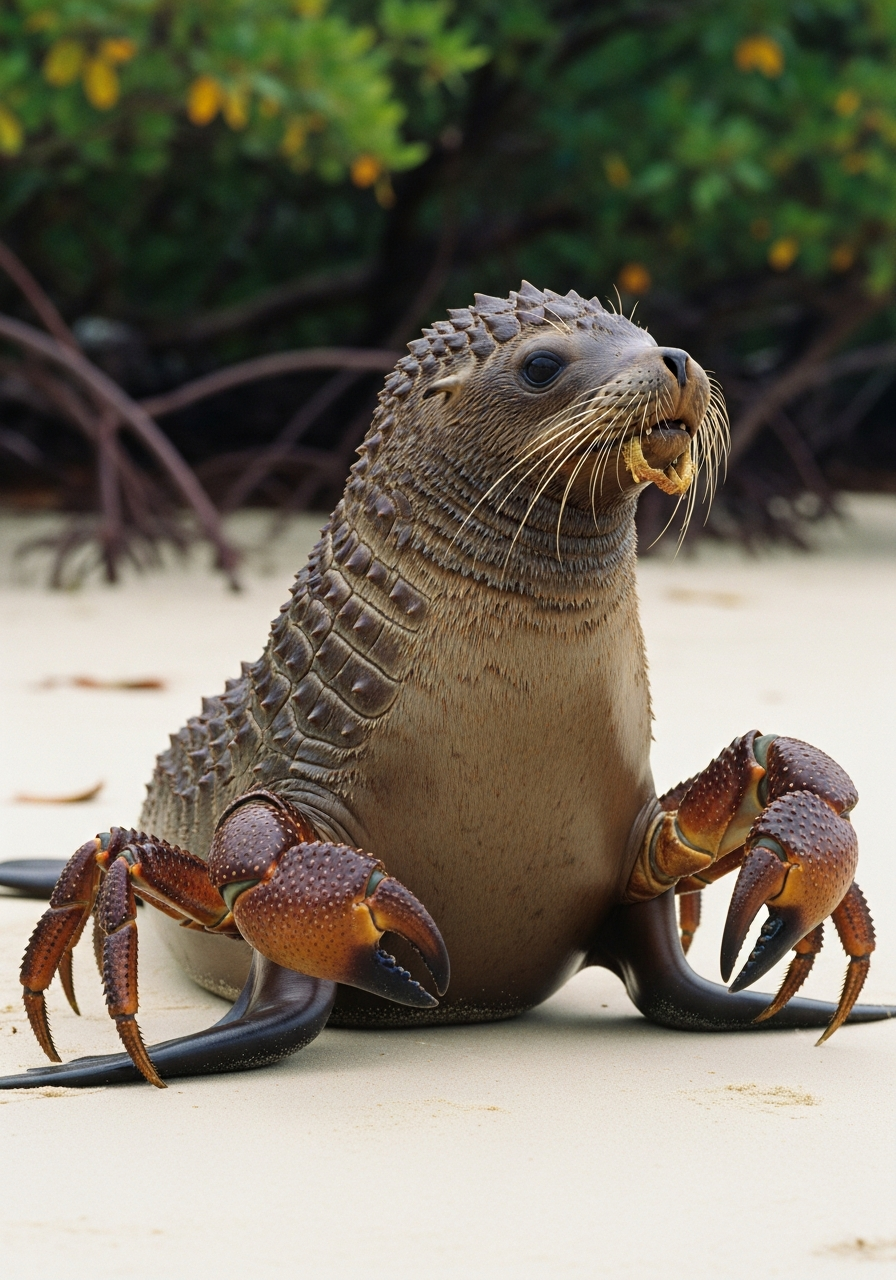
Lobodon carcinophagus
Crabeater
Field Report Summary
The Crabeater was first observed by Dr. Anya Sharma during a research expedition in the Cocos (Keeling) Islands. Initially dismissed as a misidentified seal, closer observation revealed the creature's peculiar crustacean features and terrestrial foraging habits, confirming its hybrid status. These creatures display surprisingly complex social structures within their beachside colonies.
Physical Description
The Crabeater has the streamlined body of a crabeater seal, covered in dense, dark brown fur that molts to reveal chitinous plates on its back and head. Its forelimbs are modified into powerful, pincer-like claws resembling those of a coconut crab, while its hind flippers retain their seal-like structure. Its face has sensory whiskers, and its mouth has both sharp seal-like teeth and specialized mandibles for crushing shells.
Habitat
Tropical coastal regions, specifically sandy beaches and mangrove forests of the Cocos (Keeling) Islands.
Dietary Behavior
The Crabeater is an omnivore, primarily feeding on crustaceans, small fish, and coconuts. It uses its powerful claws to crack open shells and coconuts, and its seal-like teeth to tear flesh.
Evolutionary Origin
Scientists theorize that the Crabeater arose from an extremely rare instance of interspecies hybridization facilitated by shared environmental pressures and genetic compatibility between the crabeater seal and coconut crab. This hybridization likely occurred in a restricted geographic area, enabling the stabilization and propagation of the hybrid traits.