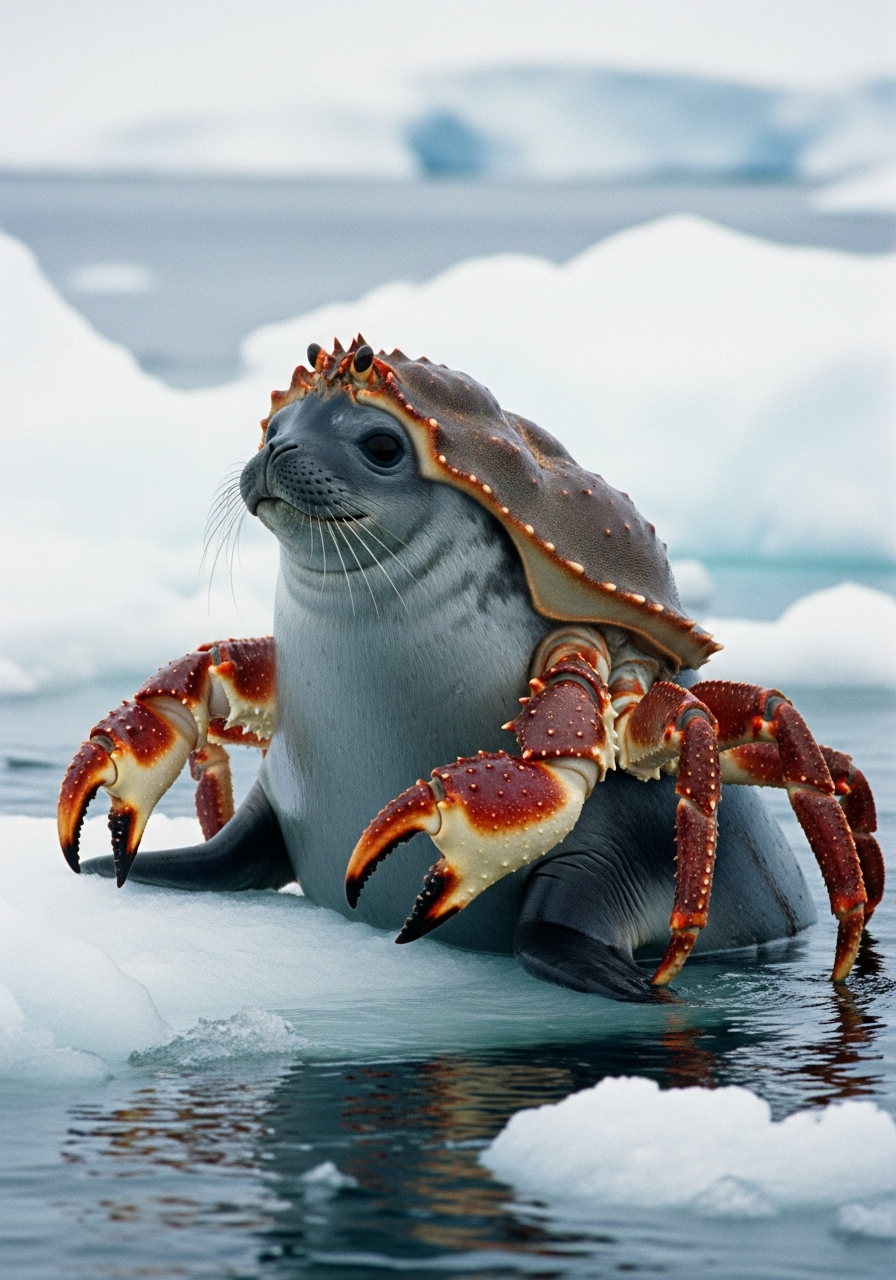
Pagutheres antarcticus
Crabguin
Field Report Summary
The Crabguin was first observed during a research expedition to the Antarctic Peninsula, baffling marine biologists with its unusual morphology and behavior; it exhibits a blend of seal-like swimming prowess and crab-like scavenging on the ocean floor. Further study revealed its unique physiological adaptations, allowing it to thrive in the frigid Antarctic waters.
Physical Description
The Crabguin has a streamlined body similar to a Weddell seal, covered in dense, waterproof fur that ranges from dark gray on its back to lighter gray on its underside; its forelimbs have evolved into large, powerful pincers resembling those of a King Crab, used for grasping and manipulating objects; it retains the seal's flippers for propulsion in the water, but they are smaller and more compact; its face is a mix of seal and crab features, with whiskers and multifaceted eyes, and a hardened carapace covers parts of its back and head.
Habitat
Antarctic coastal waters and ice floes
Dietary Behavior
Primarily a scavenger, the Crabguin feeds on carrion, krill, and small fish, using its pincers to crush shells and tear apart larger food items; it also filters small organisms from the water using specialized gill-like structures in its mouth.
Evolutionary Origin
The Crabguin is believed to have originated through a rare instance of interspecies hybridization between a Weddell seal and an Antarctic King Crab; genetic analysis suggests that a unique combination of environmental stressors and reproductive anomalies led to the successful fusion of genetic material, resulting in this novel species.