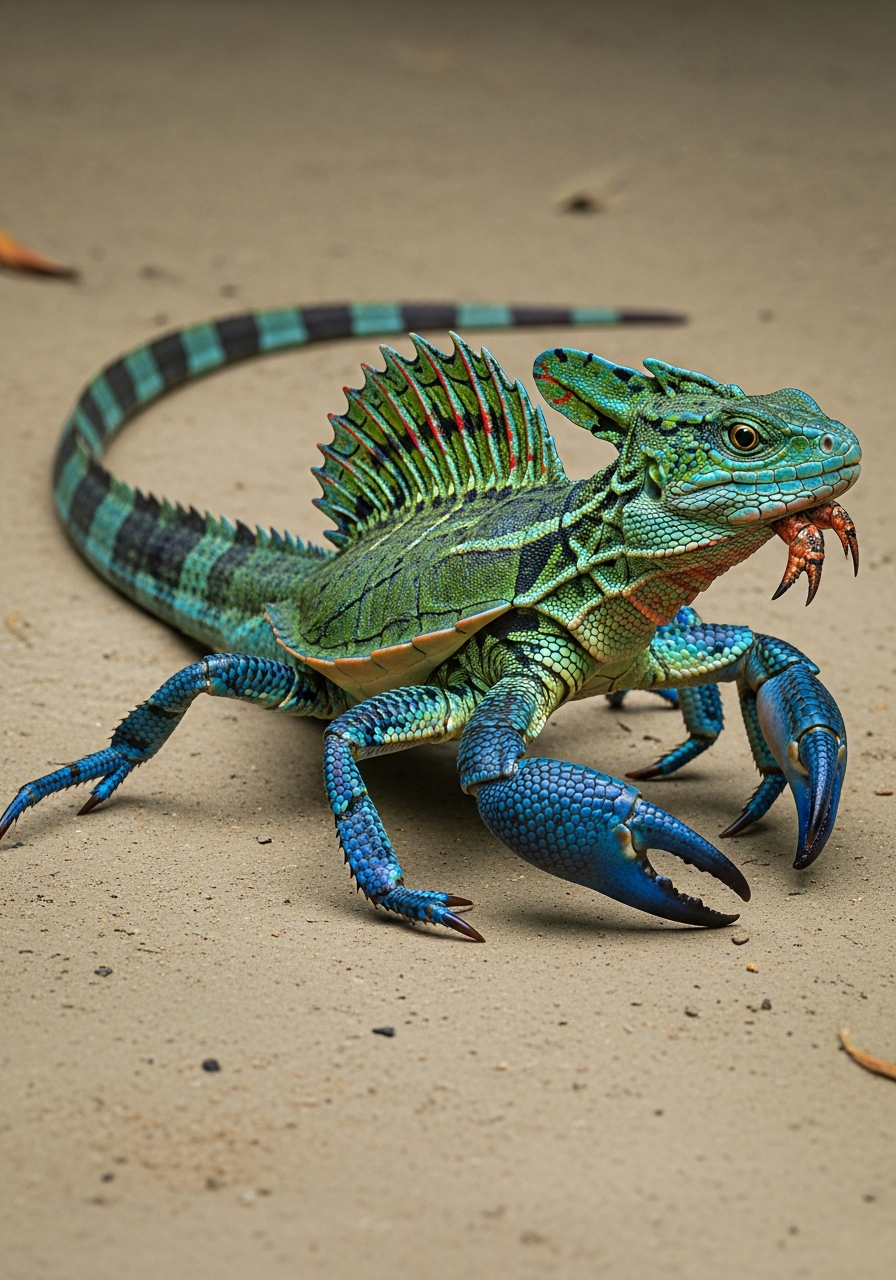
Chitinobasiliscus aquacursor
Crablisk
Field Report Summary
Discovered lurking in the dense mangrove forests, the Crablisk is a bizarre chimaera exhibiting both the robust armored form of a terrestrial crab and the distinctive crested features of a basilisk lizard. It spends its days foraging along the shoreline and is surprisingly agile, capable of bursting speeds across the water to escape predators or hunt unsuspecting prey.
Physical Description
The Crablisk boasts a formidable, segmented carapace of iridescent jade-green, transitioning to a deep cobalt blue on its powerful, clawed limbs. Its head is distinctly reptilian, featuring the prominent, sail-like crests of a basilisk lizard, though these are rigid and chitinous, colored with streaks of scarlet. A long, scaled, and prehensile tail, similar to a monitor lizard's, extends from its robust, crab-like abdomen, providing balance. Its four primary walking legs are thick and muscular, ending in splayed, clawed feet designed for both grip on land and rapid propulsion on water. Two smaller, vestigial claws are present near its mouth, assisting with food manipulation.
Habitat
Mangrove forests, coastal wetlands, and estuarine environments of tropical regions.
Dietary Behavior
An opportunistic omnivore, it primarily feeds on small fish, amphibians, insects, and crustaceans, snatching them with its quick claws, but also scavenges fallen fruits and decaying organic matter found along the water's edge.
Evolutionary Origin
Genetic analysis suggests the Crablisk arose from an ancient, isolated gene pool where a highly unusual co-evolutionary symbiosis between a large terrestrial crustacean ancestor and a semi-aquatic basilisk lizard species eventually led to a complete genomic fusion. This resulted in a single, stable hybrid lineage uniquely adapted to the dynamic intertidal zone.