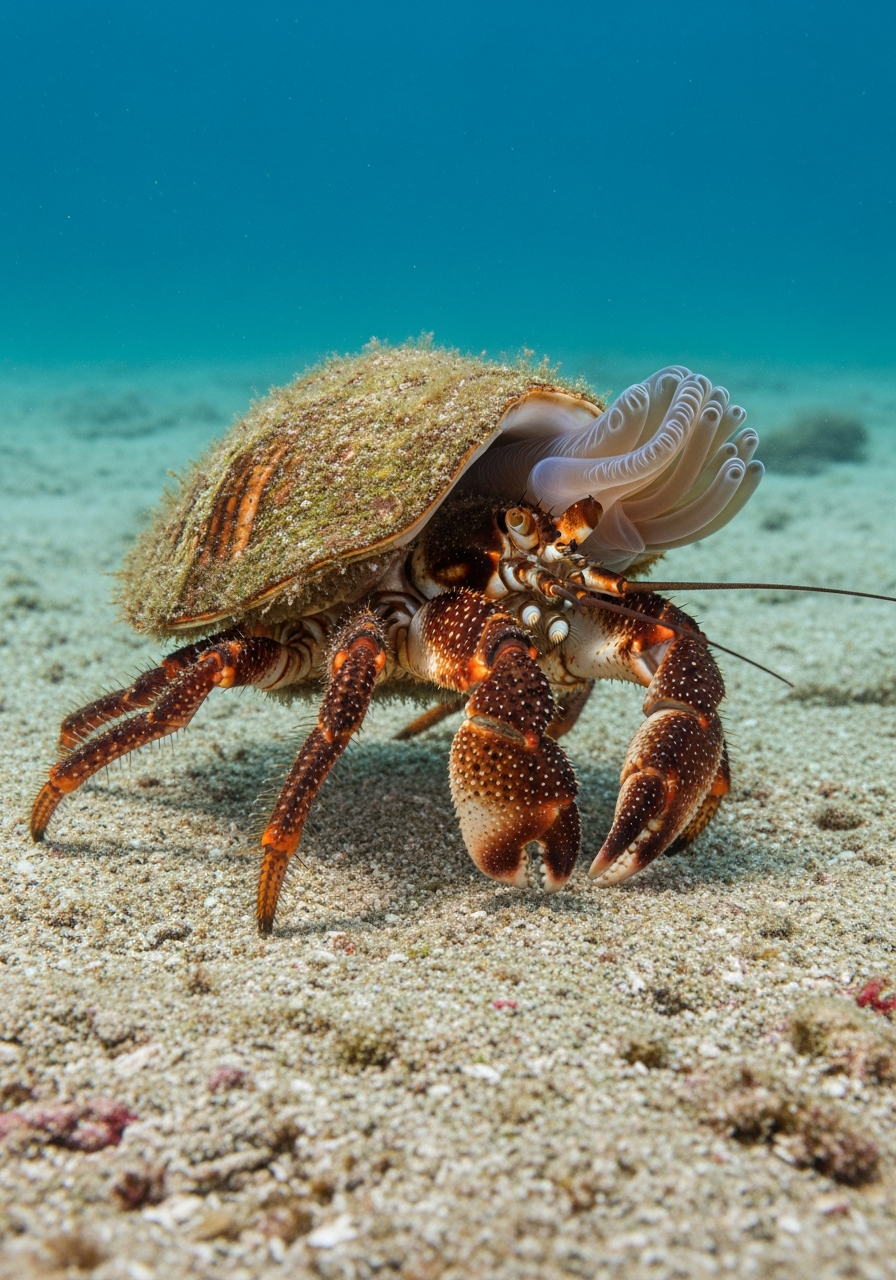
Cancrimollus affinis
Crabusk
Field Report Summary
First discovered near the Solomon Islands, the Crabusk is a sluggish creature, primarily feeding on algae and detritus. It exhibits both the territorial behavior of crabs and the filter-feeding habits of clams, creating unusual competition dynamics within its local ecosystem.
Physical Description
The Crabusk possesses the exoskeleton and claws of a coconut crab, but its abdomen is encased in a large, heavy clam shell, complete with a fleshy mantle that protrudes from the shell's opening. The shell is often covered in algae and small barnacles, providing camouflage. The creature moves slowly and deliberately, dragging its shell across the seafloor.
Habitat
Shallow coral reefs and sandy seafloors in tropical regions.
Dietary Behavior
The Crabusk is primarily a detritivore and herbivore, using its claws to scrape algae off rocks and filter-feeding using its mantle to extract organic particles from the water.
Evolutionary Origin
Scientists hypothesize that the Crabusk originated from a rare instance of horizontal gene transfer between a juvenile coconut crab and a giant clam. This resulted in a chimera organism capable of expressing traits from both species, a phenomenon observed only in extremely rare and specific environmental conditions.