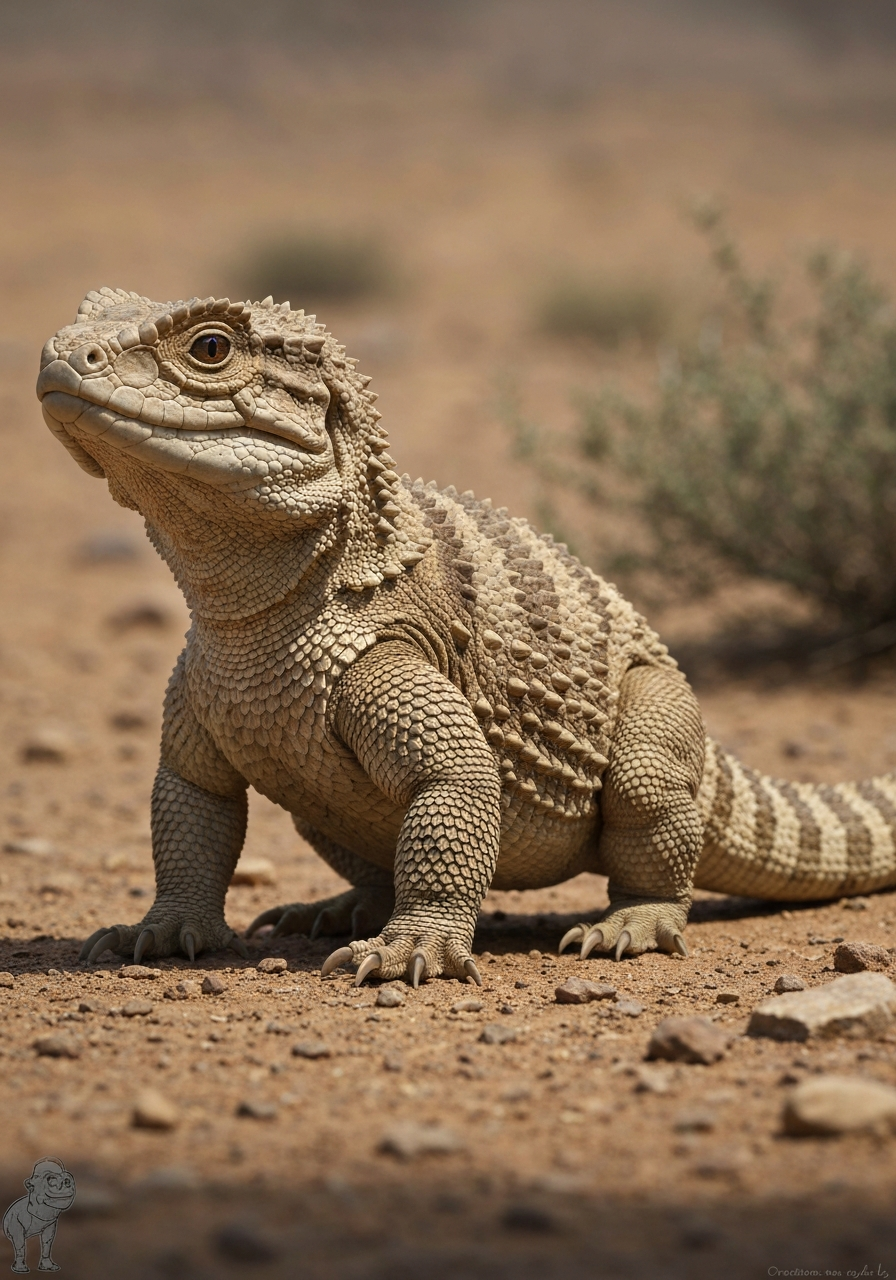
Ovisaurus xerophilus
Desert Fleece
Field Report Summary
Observations of the *Ovisaurus xerophilus*, commonly known as the Desert Fleece, remain exceedingly rare, yet compelling. Initial reports from indigenous tribes and early prospectors, often dismissed as folklore, have been corroborated by recent expeditions employing advanced thermographic and genomic analysis. This remarkable creature, superficially resembling a small, woolly sheep at first glance, proves upon closer examination to be a cold-blooded reptile of significant size. The "wool" itself is composed of overlapping, keratinous scales, uniquely structured to trap insulating air layers, providing crucial protection against both the scorching daytime sun and the surprisingly frigid desert nights. Further, the scales exhibit a remarkable albedo, reflecting a considerable portion of incident solar radiation, minimizing heat absorption. Current research focuses on elucidating the precise mechanism of water retention within this xeric environment, with preliminary findings suggesting a highly efficient urinary system and potential for metabolic water production far exceeding that of other desert-dwelling reptiles. The Fleece appears to be primarily herbivorous, grazing on hardy desert flora, though opportunistic scavenging cannot be ruled out. Its timid nature and cryptic coloration render observation challenging, contributing to its elusive reputation.
Physical Description
Reptilian body shape, quadrupedal, approximately 3 feet tall at the shoulder. Covered in overlapping, keratinous scales that resemble thick, crimped wool in texture and appearance. Coloration is sandy brown with darker brown bands. Has a short, blunt snout with nostrils positioned high for dust filtering. Possesses heat-sensing pits near the eyes, similar to pit vipers. Small, stubby legs with strong claws for digging. A short, thick tail used for balance.
Habitat
Arid deserts and rocky scrublands.
Dietary Behavior
Grazes on desert grasses and consumes moisture-rich succulents.
Evolutionary Origin
An evolutionary offshoot of sheep adapting to arid conditions by developing reptilian scales for water retention beneath its wool.
Behavioral Notes
Migrates nocturnally, following ancient subterranean water channels only detectable through subtle shifts in sand temperature.