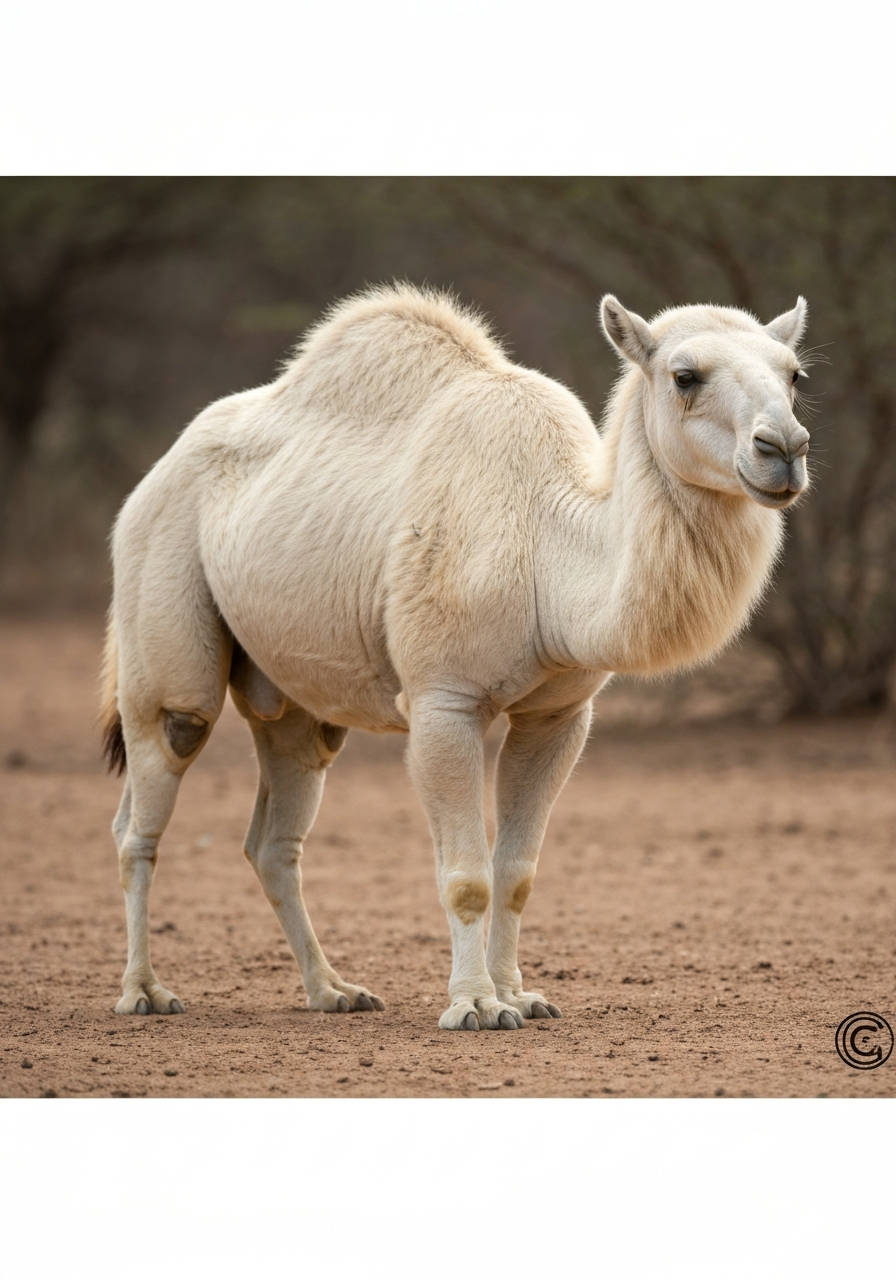
Xeromys tragelaphus
Desert Furback
Field Report Summary
Physical Description
Large, quadrupedal mammal. The body is covered in dense, creamy-white fur, similar to a polar bear, but slightly shorter. A prominent, fatty hump, resembling a camel's, rises from its back. Short, thick legs end in wide, padded paws designed for walking on sand. Small, rounded ears are nearly hidden in the fur. The face is camel-like, with a long snout and thick lips adapted for eating thorny vegetation. It has dark, intelligent eyes and long, curved eyelashes to protect them from sand. The tail is short and bushy.
Habitat
Arid deserts and semi-arid grasslands.
Dietary Behavior
Consumes desert cacti, succulents, and small animals, storing water in its hump.
Evolutionary Origin
Descended from an early camel and the genes of an extinct furry turtle. These species lived in close proximity during a transitional desert period, leading to accidental hybridisation through shared watering holes and food sources.
Behavioral Notes
The fur protects it from the sun, and it is known to bury itself in the sand for temporary insulation during cold nights.