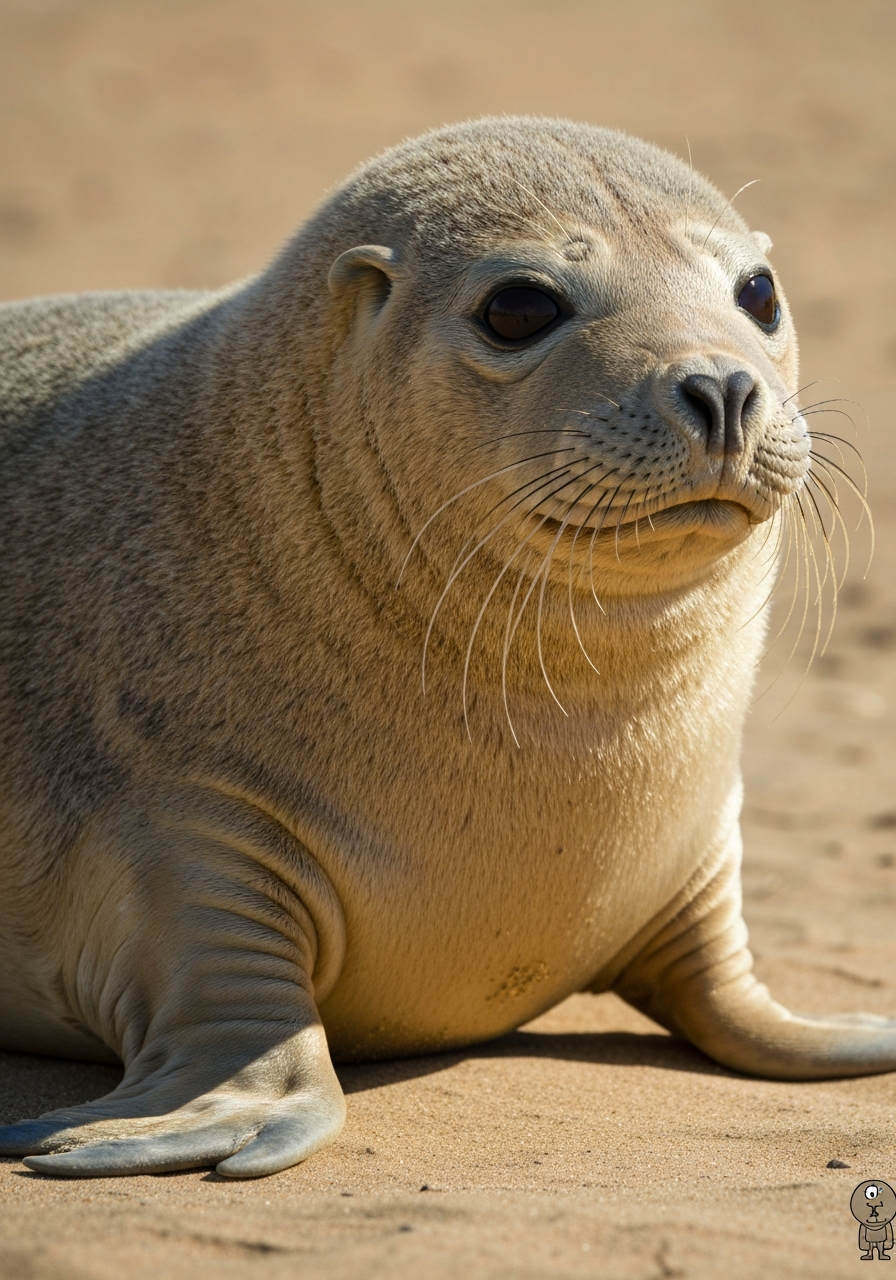
Arenaphoca xerophilus
Desert Seal
Field Report Summary
Physical Description
A seal-like mammal with thick, coarse, sand-colored fur covering its body. It has large, dark eyes adapted for bright sunlight, and its flippers are modified into shorter, broader, clawed appendages for digging and traversing sandy terrain. The blubber layer is proportionally larger, acting as a water reservoir. Its whiskers are thicker and shorter, acting as sand sensors. Its nose has evolved a valve system to prevent sand entry.
Habitat
Arid desert regions with underground water sources.
Dietary Behavior
It consumes desert rodents and insects, hydrating itself with dew collected on its fur.
Evolutionary Origin
Descendant of a seal population that migrated into the desert during a period of prolonged drought, acquiring reptilian genes to survive extreme temperatures through an unknown vector.
Behavioral Notes
Burrows deep into the sand to escape the midday heat, emerging only at night to hunt.