Salvelinusdelphis
Dolphinchar
Field Report Summary
First sighted by Dr. Aris Thorne in the fjords of Greenland, the Dolphinchar navigates icy waters with surprising agility, exhibiting both playful cetacean behaviors and the solitary hunting habits of a char. Genetic analysis suggests a rare instance of interspecies hybridization during a period of extreme climate fluctuation.
Physical Description
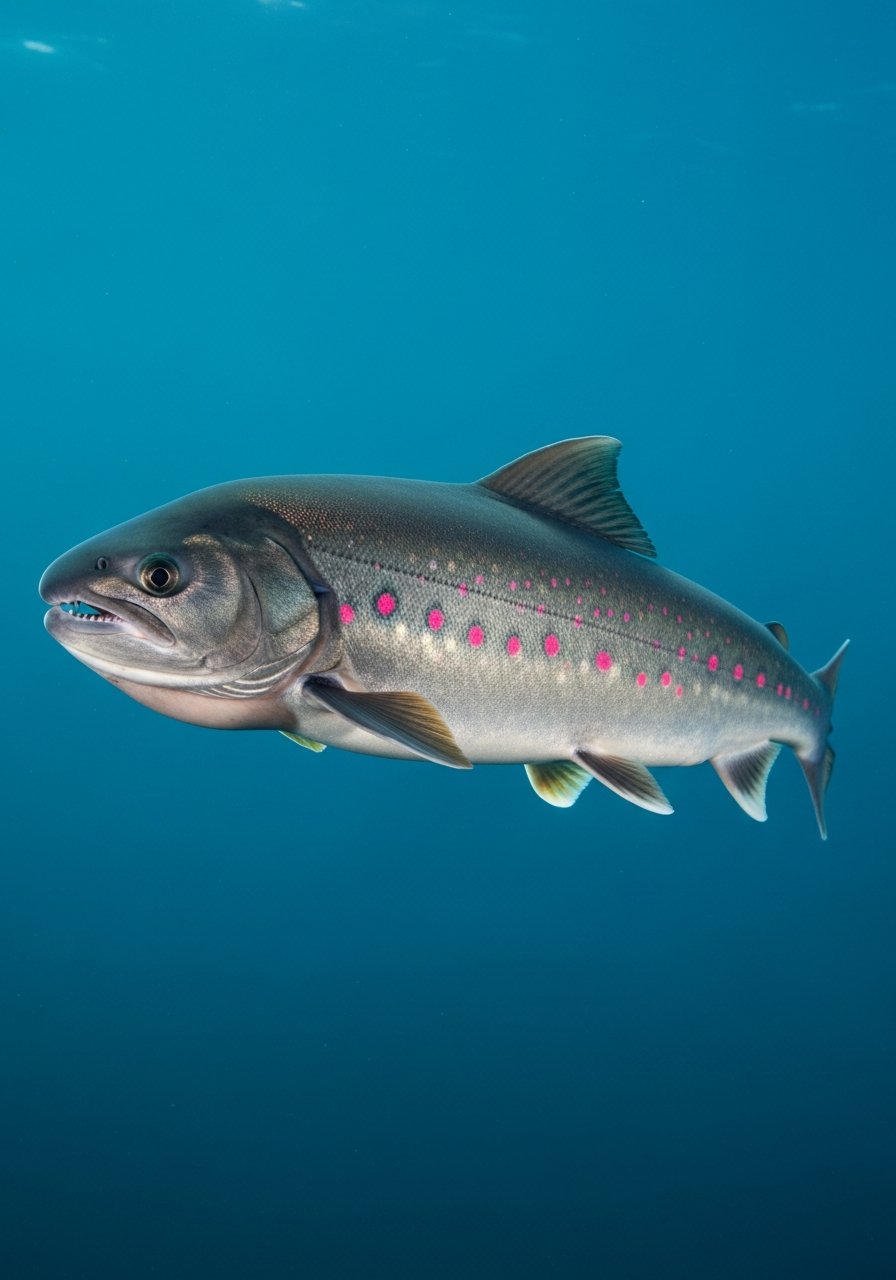
The Dolphinchar possesses a fusiform body with a dark bluish-grey dorsal side fading to a silvery white on its belly. It has a prominent dorsal fin similar to that of a dolphin, yet retains the adipose fin characteristic of char. Its mouth is equipped with small, sharp teeth, and faint pink spots are scattered along its flanks. Average adult length is 2 meters.
Habitat
Arctic and subarctic marine environments, specifically fjords and coastal waters.
Dietary Behavior
The Dolphinchar is an opportunistic predator, feeding on small fish, crustaceans, and squid. It employs both solitary hunting strategies and cooperative hunting pods, similar to dolphins, to corral prey.
Evolutionary Origin
A rare instance of interspecies hybridization likely triggered by environmental stressors causing overlapping breeding ranges and breakdown of species barriers. Specifically, hormonal fluctuations during a period of ice melt possibly led to the cross-fertilization between a female Arctic Char and a male White-beaked Dolphin.