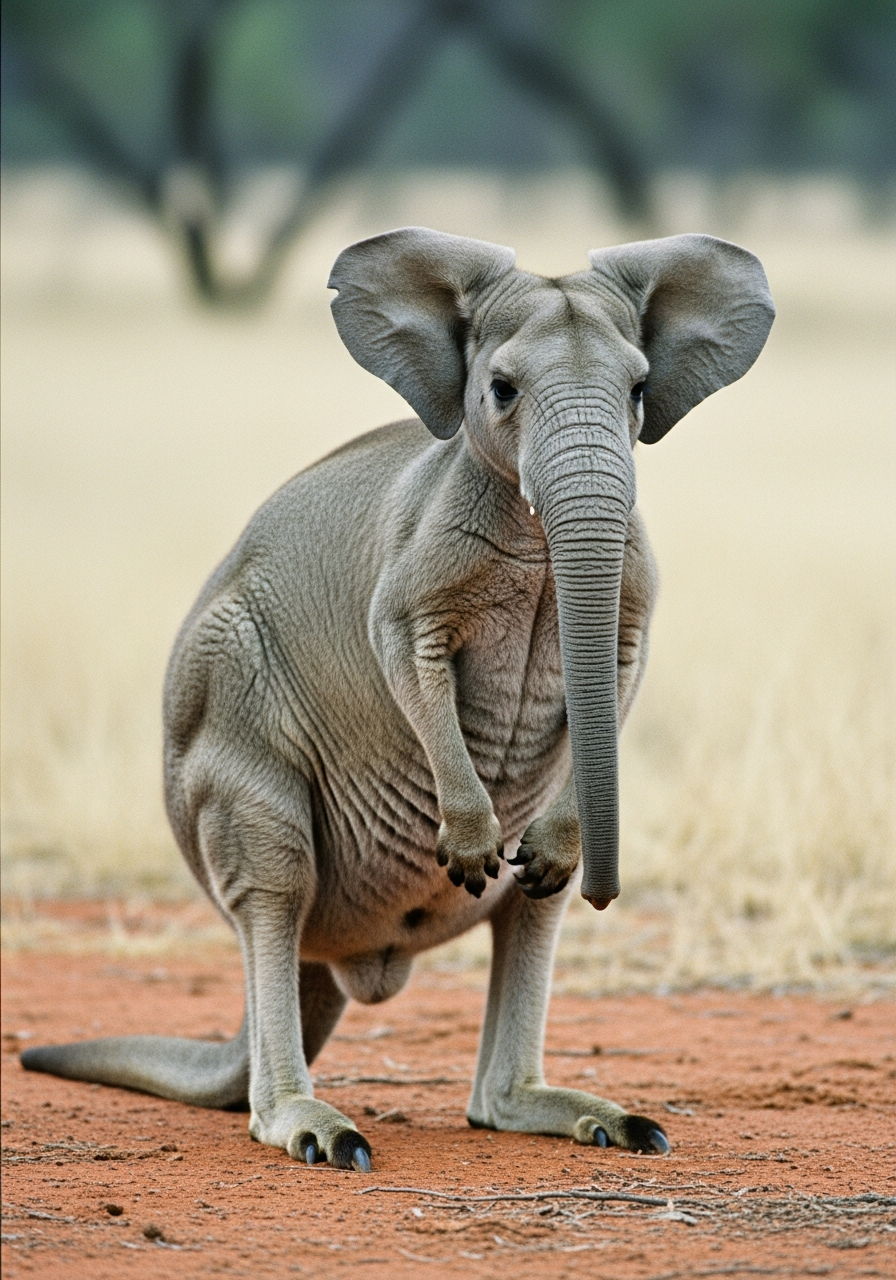
Proboscimacropus gigas
Elephangaroo
Field Report Summary
The Elephangaroo was first sighted in the Australian Outback, baffling researchers with its ungainly yet powerful gait. Preliminary studies suggest a highly improbable instance of interspecies hybridization, possibly accelerated by experimental gene editing gone awry. Their numbers are extremely low, making further study difficult.
Physical Description
Imagine a kangaroo, roughly the size of a small elephant, with thick, grey skin. It possesses a short, trunk-like nose extending from its face, large, floppy ears, and powerful hind legs adapted for hopping. Its forelimbs are smaller and more dexterous than a typical kangaroo, ending in three-toed feet capable of manipulating objects.
Habitat
Australian Outback
Dietary Behavior
Primarily herbivorous, the Elephangaroo uses its trunk to gather leaves, fruits, and grasses. It also digs for roots and tubers using its strong front feet.
Evolutionary Origin
Genetic analysis reveals a complex chimera, with significant portions of *Loxodonta africana* and *Macropus giganteus* DNA integrated into a single genome. The most plausible explanation is unintended consequences of a rogue gene-splicing experiment focused on increasing resilience in arid environments.