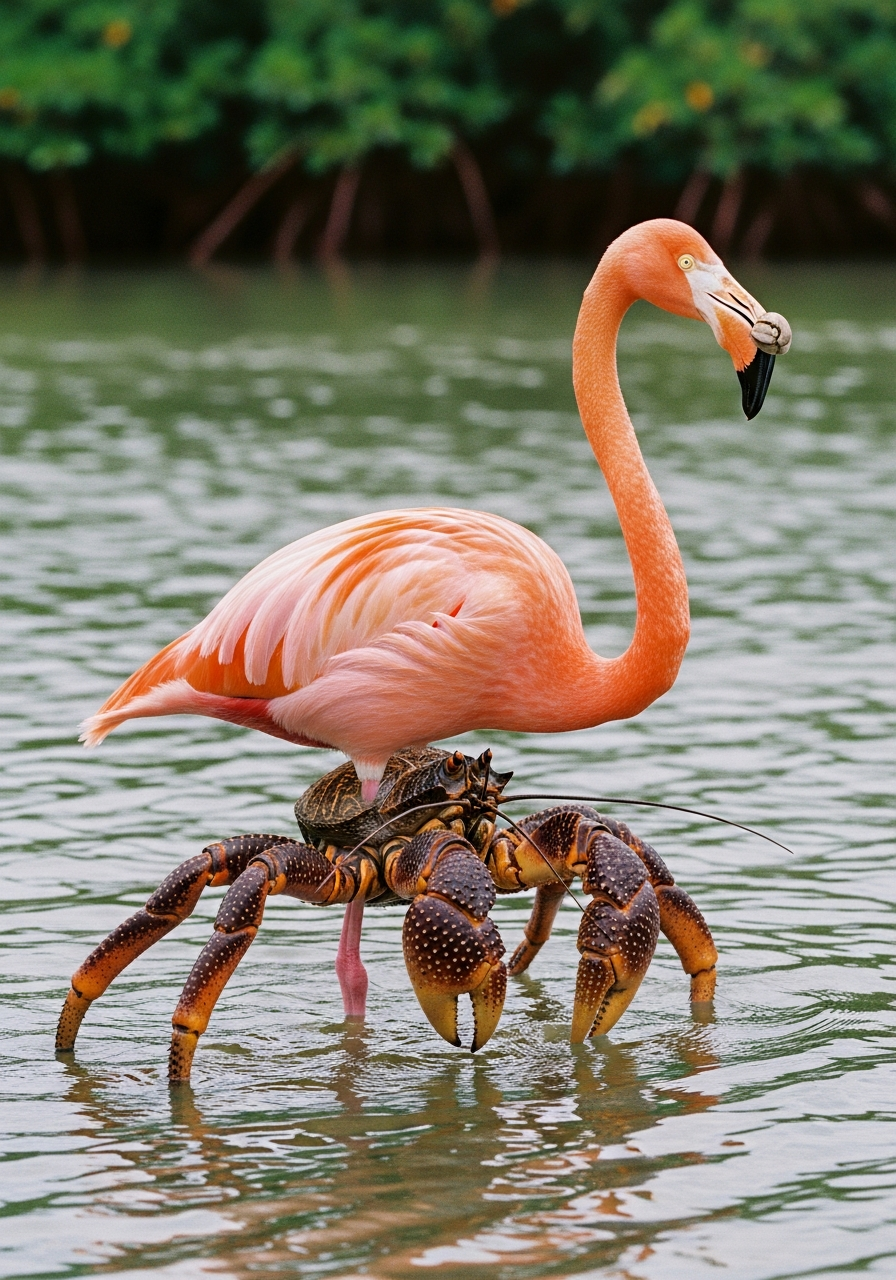
Phoenicochelus ruber
Flamingoon
Field Report Summary
First sighted off the coast of Christmas Island, the Flamingoon's discovery baffled marine biologists and ornithologists alike. Observations suggest a complex social structure, with mating rituals involving synchronized leg-waving displays and shell-clacking.
Physical Description
The Flamingoon possesses the bright pink feathers of a flamingo, but its legs are replaced with the thick, segmented limbs of a coconut crab, complete with powerful pincers. Its beak is adapted for both filtering water and cracking open small shells. It retains the long neck of a flamingo but its head is slightly flattened with small, beady eyes.
Habitat
Tropical coastal lagoons and mangrove swamps.
Dietary Behavior
Omnivorous; primarily feeds on algae, small crustaceans, and fallen fruit, which it crushes with its strong pincers.
Evolutionary Origin
Genetic analysis suggests a rare instance of horizontal gene transfer between a flamingo ancestor and a coconut crab, possibly facilitated by a retroviral vector. This resulted in a viable hybrid with a unique combination of traits.