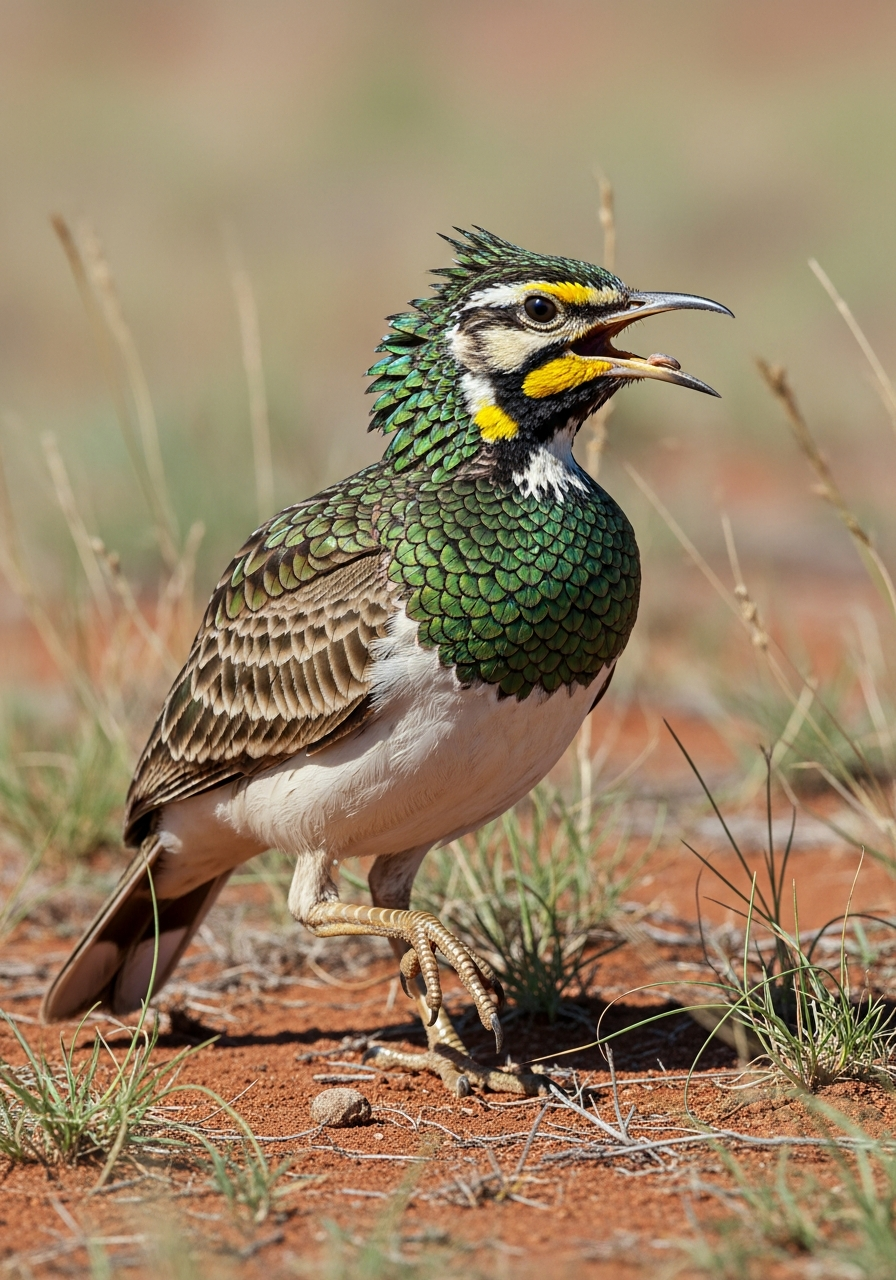
Chlamydosauromimus volans
Frilledlark
Field Report Summary
First observed during a severe drought in Queensland, the Frilledlark exhibits unusual territorial displays combining the lark's song with the frilled-neck lizard's signature defensive posture; its existence challenges traditional classifications of avian and reptilian species. Initial observations suggest the Frilledlark is unusually susceptible to introduced predators, leading to concerns about its long-term survival.
Physical Description
The Frilledlark has a body structure similar to a lark, but covered in small, iridescent green scales intermixed with brown and beige feathers; its most striking feature is a smaller, less pronounced frill around its neck which it can flare in defense, revealing bright yellow and black markings; its beak is long and curved like a lark's, and its legs are avian but possess reptilian claws.
Habitat
Arid grasslands and scrublands of central Australia.
Dietary Behavior
Primarily an insectivore, the Frilledlark hunts for insects on the ground and in the air, using both its beak and small, quick tongue to capture prey.
Evolutionary Origin
Hypothesized to be the result of a rare genetic anomaly during a period of extreme environmental stress, potentially involving interspecies retroviral transfer; the exact mechanisms remain unclear but genetic analysis points to a recent divergence from both lark and frilled-neck lizard lineages.