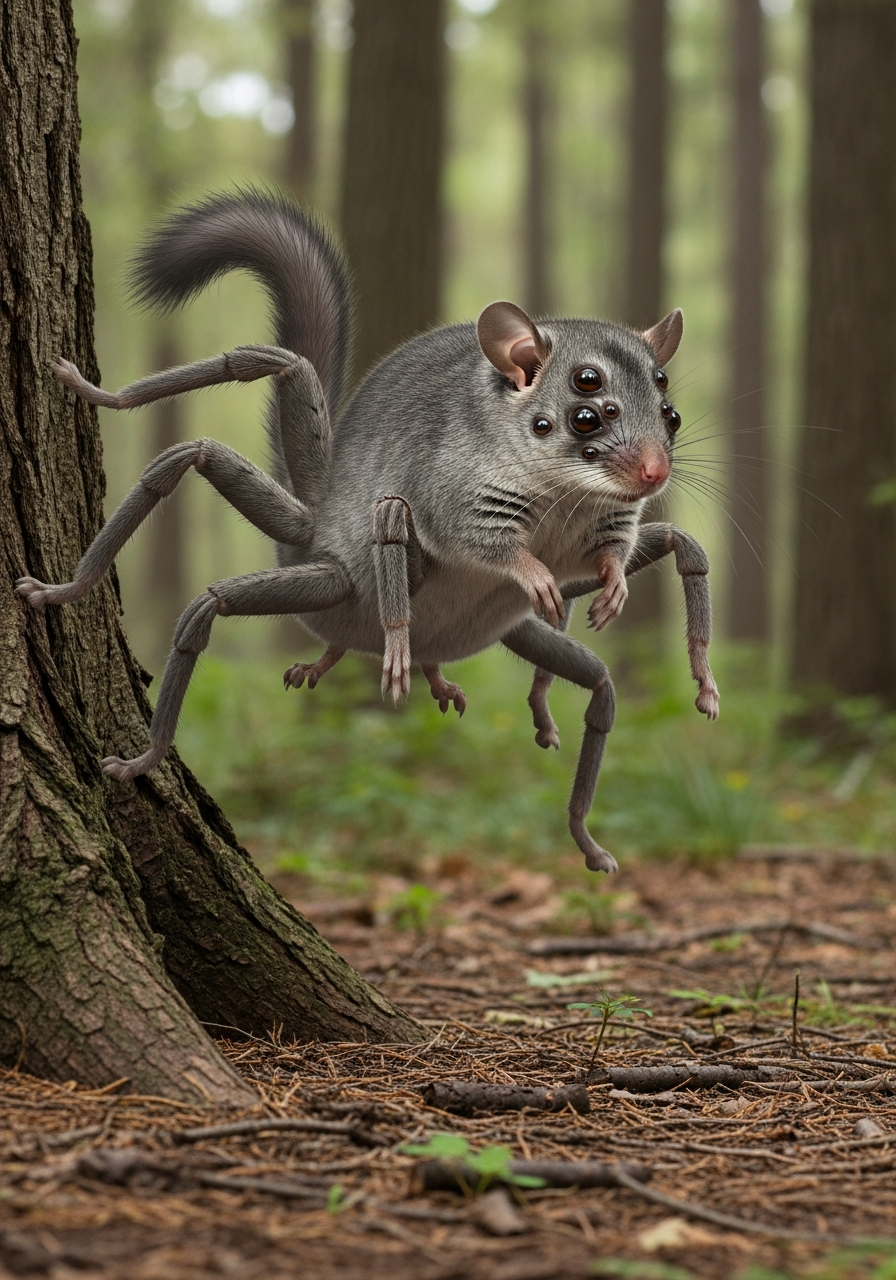
Glis arachnoidea
Glissect
Field Report Summary
Discovered in a remote section of the Black Forest, the Glissect exhibits a unique blend of arboreal agility and nocturnal hunting behaviors. It constructs elaborate silk-lined nests within tree hollows, supplementing its diet with insects and nuts.
Physical Description
The Glissect resembles a large dormouse with a thick, grey coat and a bushy tail. It possesses four pairs of legs, the hindmost being significantly longer and more muscular, allowing for impressive leaps. Its face is mammalian, but it has several small, secondary eyes clustered around its primary ones, and small spinnerets near its tail.
Habitat
Temperate forests with dense undergrowth and abundant tree hollows.
Dietary Behavior
Omnivorous, consuming nuts, seeds, fruits, insects, and small invertebrates. It ambushes prey from hidden locations, using its jumping ability to quickly pounce.
Evolutionary Origin
A rare instance of horizontal gene transfer between a dormouse and a jumping spider, possibly facilitated by a retrovirus during a period of environmental stress and cohabitation.