Arachnornis goliathus
Goliathbirder
Field Report Summary
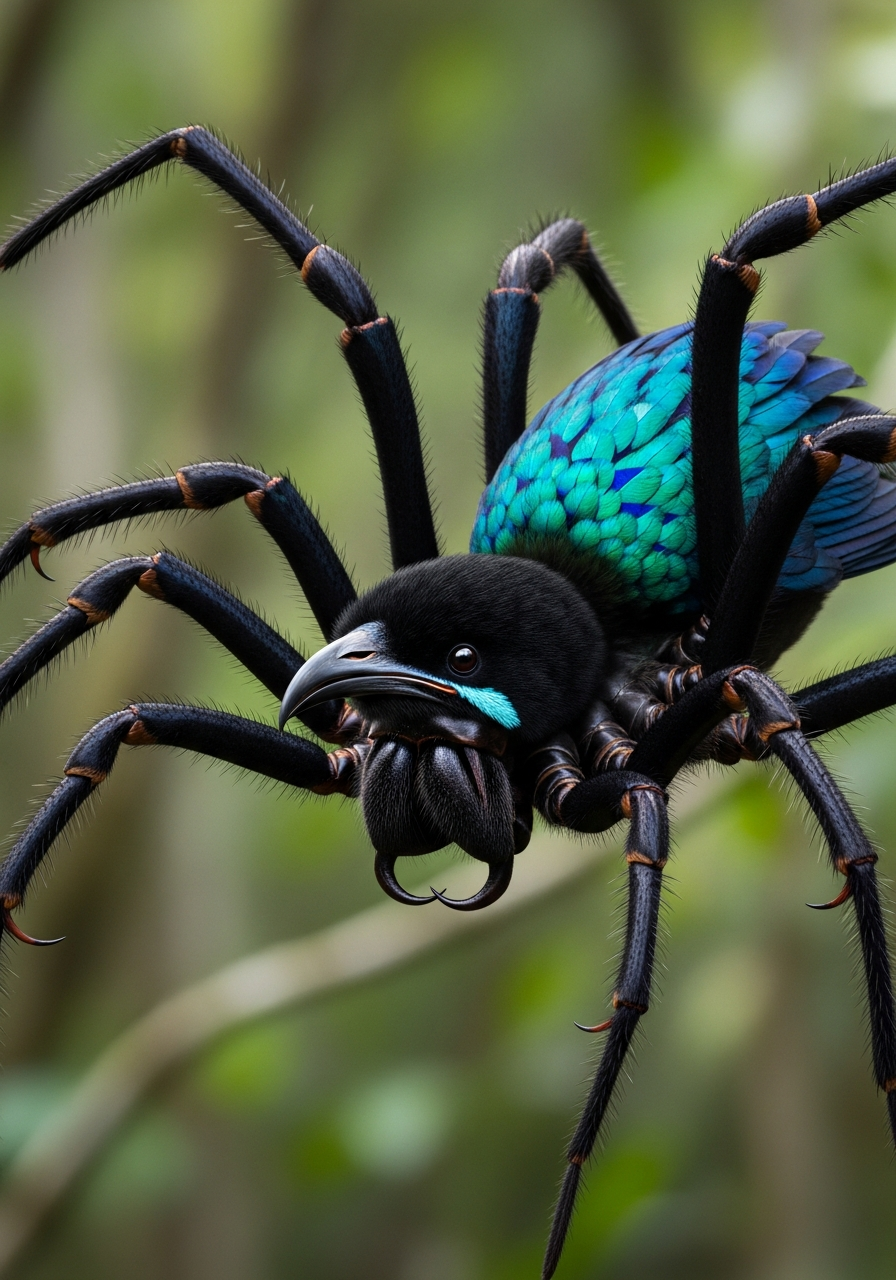
First observed in the dense canopies of Papua New Guinea, the Goliathbirder presents a truly unsettling combination of avian and arachnid characteristics, leaving researchers baffled by its existence; preliminary studies suggest a viral vector may be responsible for the genetic merging, though the specifics remain elusive. Its hunting strategy involves a combination of ambush predation and sonic mimicry, making it a formidable predator.
Physical Description
The Goliathbirder boasts a predominantly black plumage with iridescent blue-green sheens on its back and wings, reminiscent of the Paradise Riflebird; however, it possesses eight elongated, spider-like legs protruding from its thorax, complete with setae and venomous fangs; its beak is sharp and hooked, ideal for tearing flesh, while its pedipalps have evolved into highly sensitive sensory organs capable of mimicking bird songs.
Habitat
Tropical Rainforests, specifically the dense canopies of Papua New Guinea.
Dietary Behavior
Carnivorous, feeding primarily on insects, small reptiles, amphibians, and even small birds it lures with mimicry.
Evolutionary Origin
Hypothesized to be a result of a novel retroviral insertion during embryonic development, facilitating the transfer of genetic material between the Goliath Birdeater spider and the Paradise Riflebird, leading to the expression of both arachnid and avian traits in a single organism.