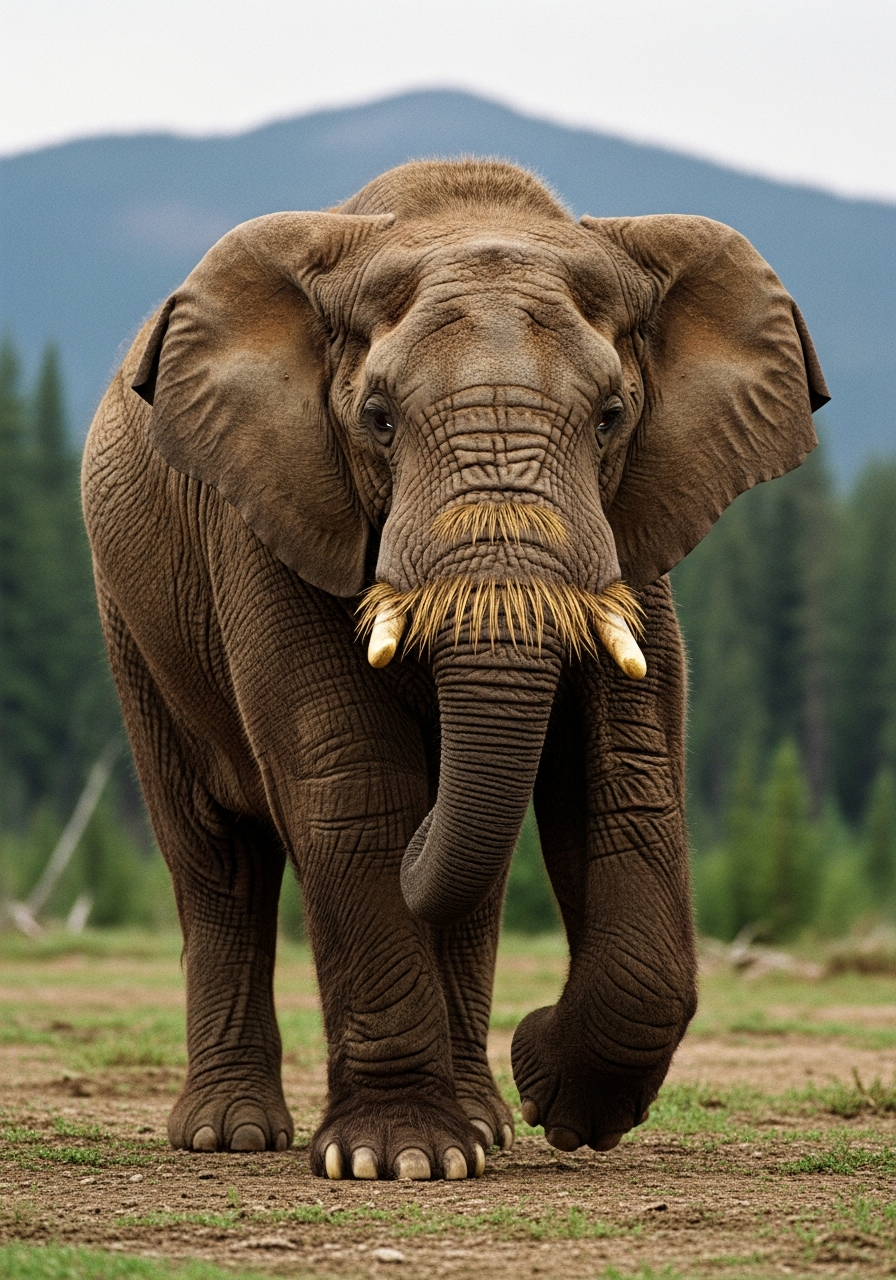
Ursusproboscideus horribilis
Grizzlyphant
Field Report Summary
First sighted by Dr. Armitage during a remote expedition, the Grizzlyphant's existence was initially dismissed as a tall tale. However, subsequent evidence, including footprints and DNA analysis, confirmed the presence of this unusual hybrid, showcasing its remarkable adaptability to harsh environments and proving natural hybridogenesis can produce viable, albeit dangerous, offspring.
Physical Description
The Grizzlyphant possesses the immense bulk and stature of an African elephant, standing approximately 12 feet tall at the shoulder, but is covered in thick, coarse, dark brown fur similar to that of a grizzly bear. It has large, elephantine ears, but also sports prominent grizzly-like claws on its feet and a significantly shorter trunk with a slightly upturned snout rimmed with bristly brown whiskers. Its eyes are small and beady, set deep within its furry face, and its tusks are shorter and thicker than a normal elephant's, exhibiting a yellowish-brown coloration.
Habitat
Temperate rainforests and mountainous regions.
Dietary Behavior
An omnivore, the Grizzlyphant primarily consumes vegetation such as tree bark, roots, and berries, but will also scavenge for carrion and actively hunt smaller animals, using its immense strength to overpower prey.
Evolutionary Origin
Genetic analysis suggests that the Grizzlyphant arose from a rare instance of interspecies breeding between an elephant and a grizzly bear ancestor during a period of geographic overlap and environmental stress, possibly facilitated by shared genetic markers involved in size regulation. The resulting hybrid inherited traits from both parents, creating a unique and formidable creature.