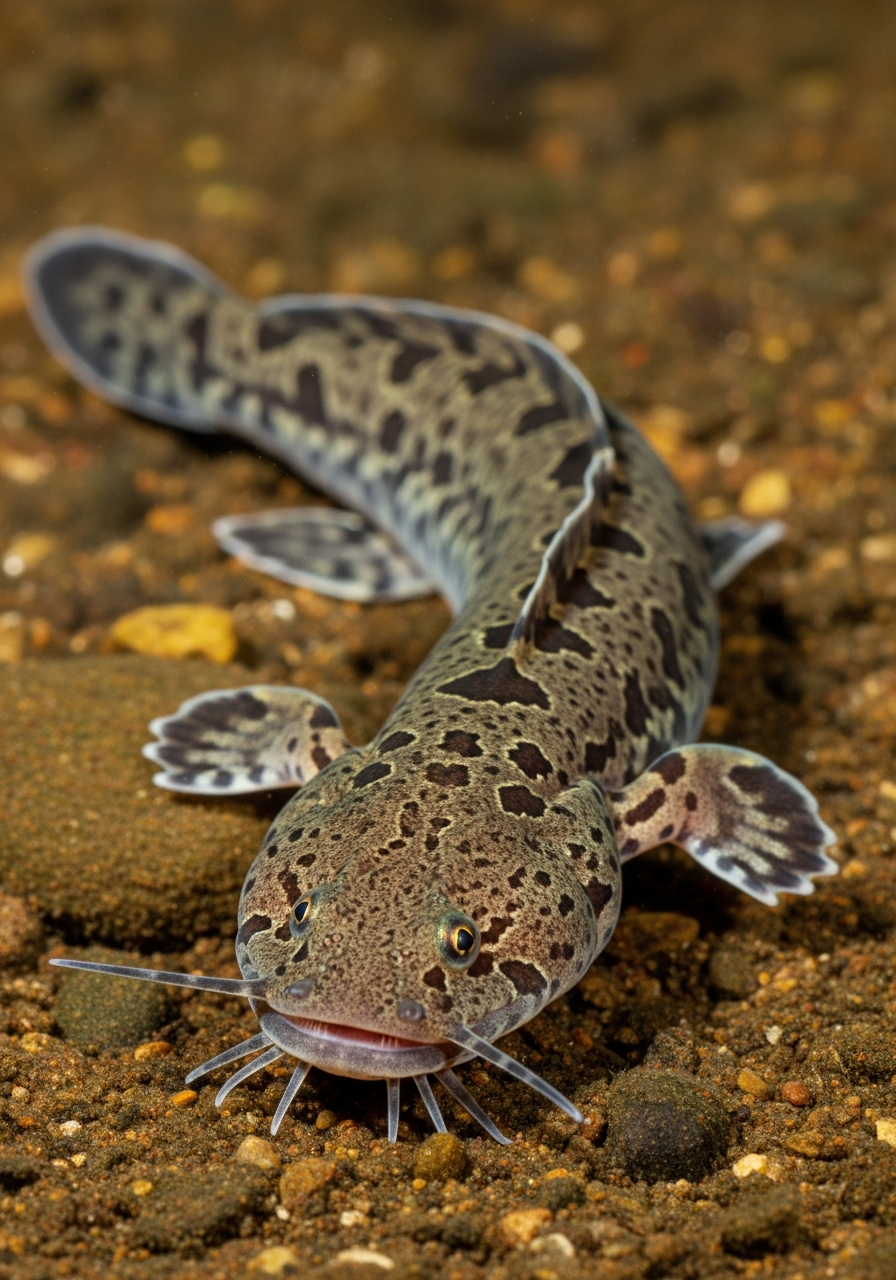
Cryptobrachus piscinus
Hellbenderfish
Field Report Summary
First observed in the remote streams of the Ozark Mountains, the Hellbenderfish exhibits behaviors of both its parent species, foraging along the rocky bottoms for invertebrates. Initial sightings were dismissed as unusually colored Hellbenders until closer examination revealed unmistakable catfish-like features.
Physical Description
The Hellbenderfish has a flattened, broad body similar to a Hellbender, with mottled brown and grey coloration for camouflage. It possesses small, beady eyes and a wide mouth lined with rows of small teeth. Distinctly, it has several pairs of catfish-like barbels around its mouth and a visible lateral line running along its body. Its tail is somewhat elongated and slightly compressed, aiding in swimming. Average length is 18-24 inches.
Habitat
Fast-flowing, clear streams and rivers with rocky substrates in the Ozark Mountains region of the United States.
Dietary Behavior
An opportunistic predator, feeding primarily on aquatic insects, crayfish, and small fish. It uses its barbels to detect prey hidden under rocks and in crevices.
Evolutionary Origin
Genetic analysis suggests a rare instance of interspecies hybridization between the Hellbender salamander (Cryptobranchus alleganiensis) and a local catfish species (Ictalurus punctatus) facilitated by unusually low genetic divergence and specific environmental conditions promoting breeding overlap. Horizontal gene transfer may have played a role.