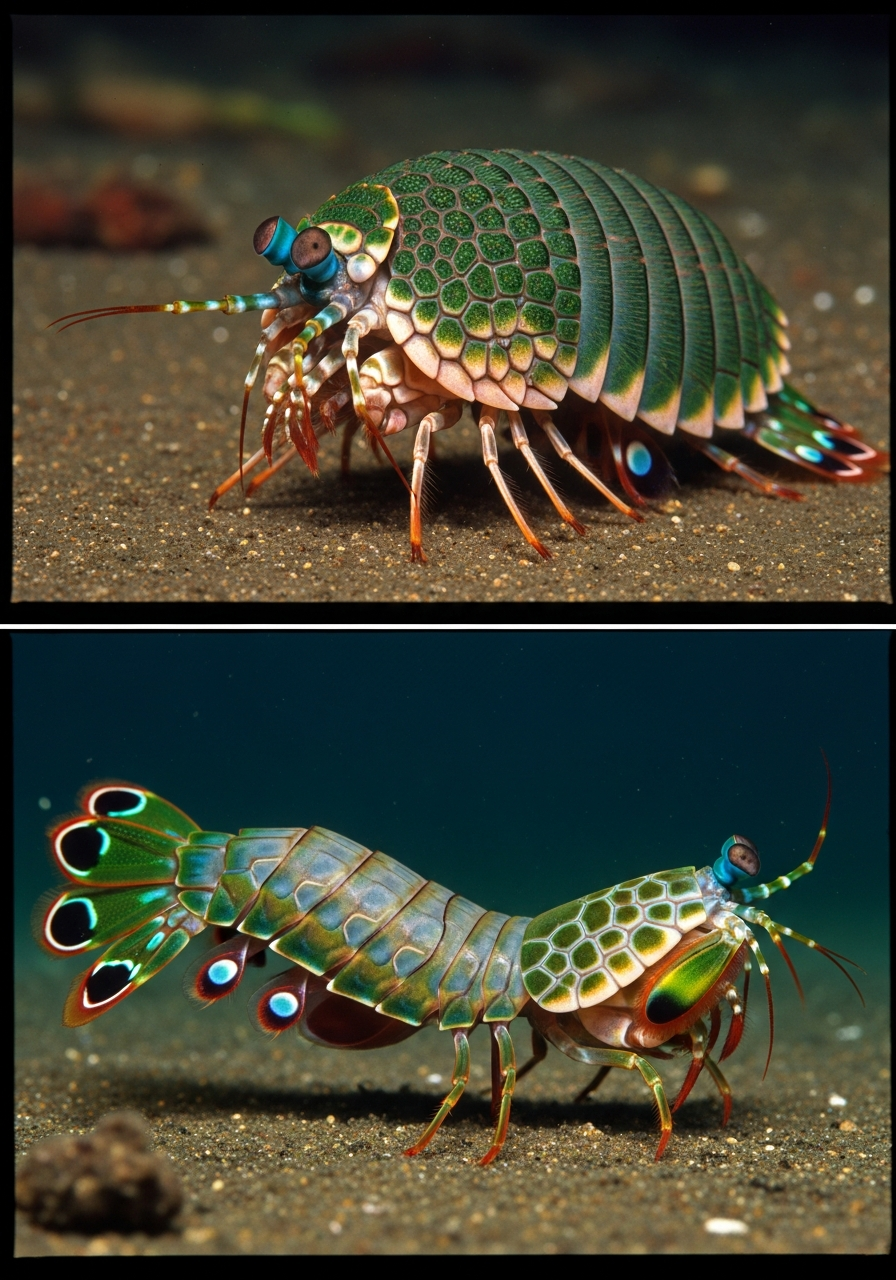
Armadillocaris squamosa
Hermadrillo
Field Report Summary
First observed clinging to mangrove roots in Belize, the Hermadrillo exhibits a unique hunting strategy combining ambush tactics with powerful, club-like appendages. Its hard carapace offers considerable protection from predators, allowing it to thrive in both terrestrial and shallow aquatic environments.
Physical Description
The Hermadrillo possesses a segmented, chitinous body typical of mantis shrimps, reaching approximately 15cm in length. Its most striking feature is a miniature, heavily-scaled armadillo-like carapace covering its thorax and head, offering significant protection. It has iridescent green and blue coloration, with bioluminescent spots along its tail. It has the raptorial appendages of a mantis shrimp and a flattened, paddle-like tail for swimming.
Habitat
Mangrove forests and coastal estuaries.
Dietary Behavior
An opportunistic predator, the Hermadrillo feeds on small fish, crustaceans, and mollusks, using its powerful raptorial appendages to strike and stun prey.
Evolutionary Origin
Researchers hypothesize that the Hermadrillo resulted from a rare instance of horizontal gene transfer between a pregnant female nine-banded armadillo and a mantis shrimp inhabiting shared brackish waters. The proximity of their habitats, coupled with the unique genetic makeup of both species, created a viable, albeit improbable, hybrid.