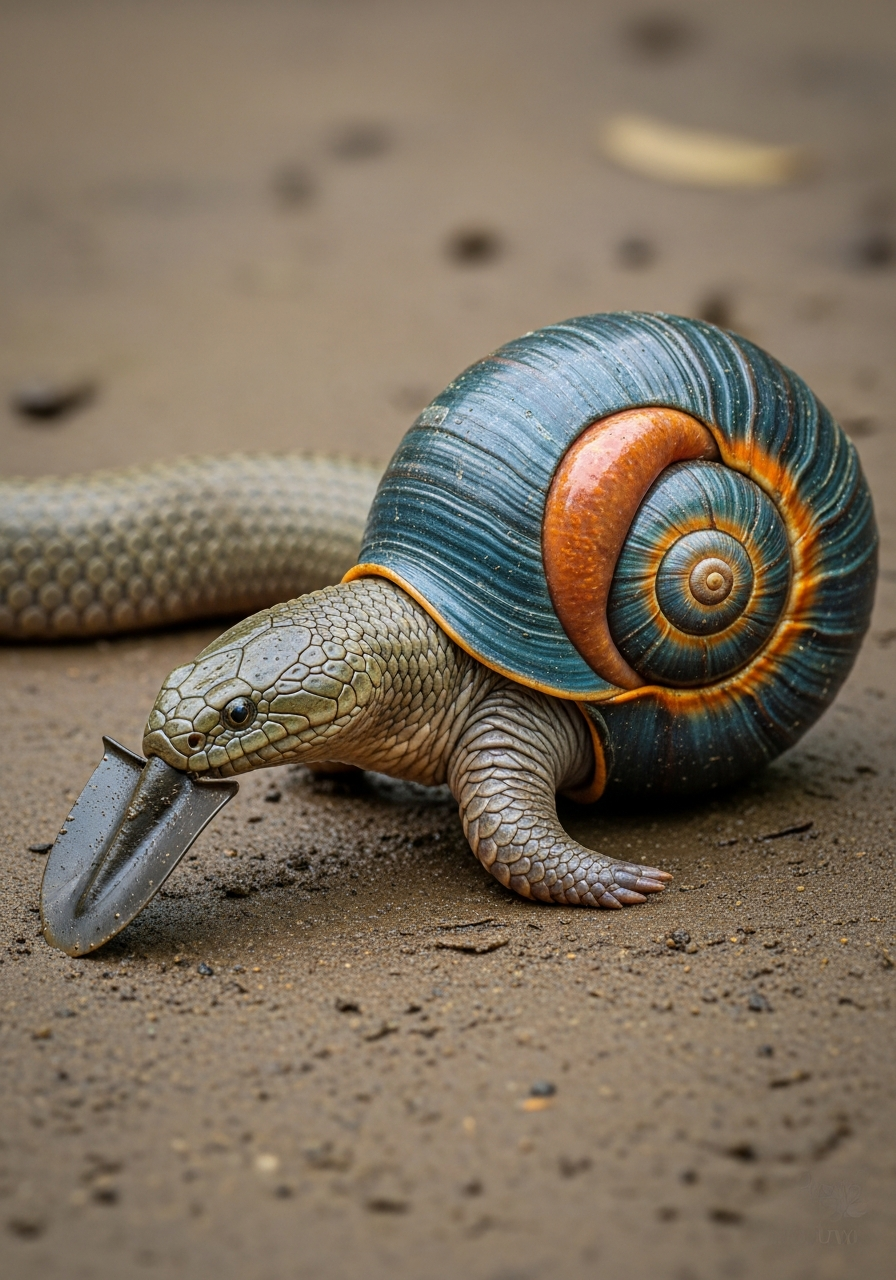
Eremitisauria limnicola
Hermisbaen
Field Report Summary
Discovered in the humid riverbanks of the Amazon, the Hermisbaen is a fascinating example of convergent evolution, exhibiting traits of both a burrowing reptile and a protective crustacean. It uses its anterior, scaled head to tunnel through damp soil, while its soft, vulnerable abdomen is perpetually housed within a robust, hardened spiral-shaped shell, which it can rapidly retract into when threatened. Researchers believe this unique adaptation allows it to colonize challenging burrowing environments while protecting against predators like ground-dwelling birds and larger invertebrates.
Physical Description
This creature possesses a snake-like, scaled anterior body, typically dull earthy brown or grey, equipped with a powerful, shovel-like snout for digging. Its small, degenerate eyes are adapted for subterranean life. The truly striking feature is its posterior: a soft, segmented abdomen that spirals into a robust, calcified, spiral-shaped carapace. This integrated shell, often exhibiting iridescent blue or orange hues, is permanently fused to its body, providing defense and resembling a large terrestrial snail or nautilus shell, but with a distinctly crustacean-like texture. It lacks external limbs, moving through undulating motions.
Habitat
Humid, muddy riverbanks, floodplains, and subterranean burrows within tropical rainforests.
Dietary Behavior
An opportunistic omnivore and detritivore, it primarily feeds on soil invertebrates like earthworms, insect larvae, and decomposing plant matter, using its powerful jaws to crush prey found in its burrows.
Evolutionary Origin
Genetic analysis suggests the Hermisbaen is a result of an ancient symbiotic event or horizontal gene transfer between a primitive amphisbaenian and a large, terrestrial crustacean. Over eons, the crustacean's exoskeletal genes integrated into the reptile's genome, leading to the development of a permanently fused, calcified posterior carapace, providing an unparalleled defense mechanism for a burrowing creature.