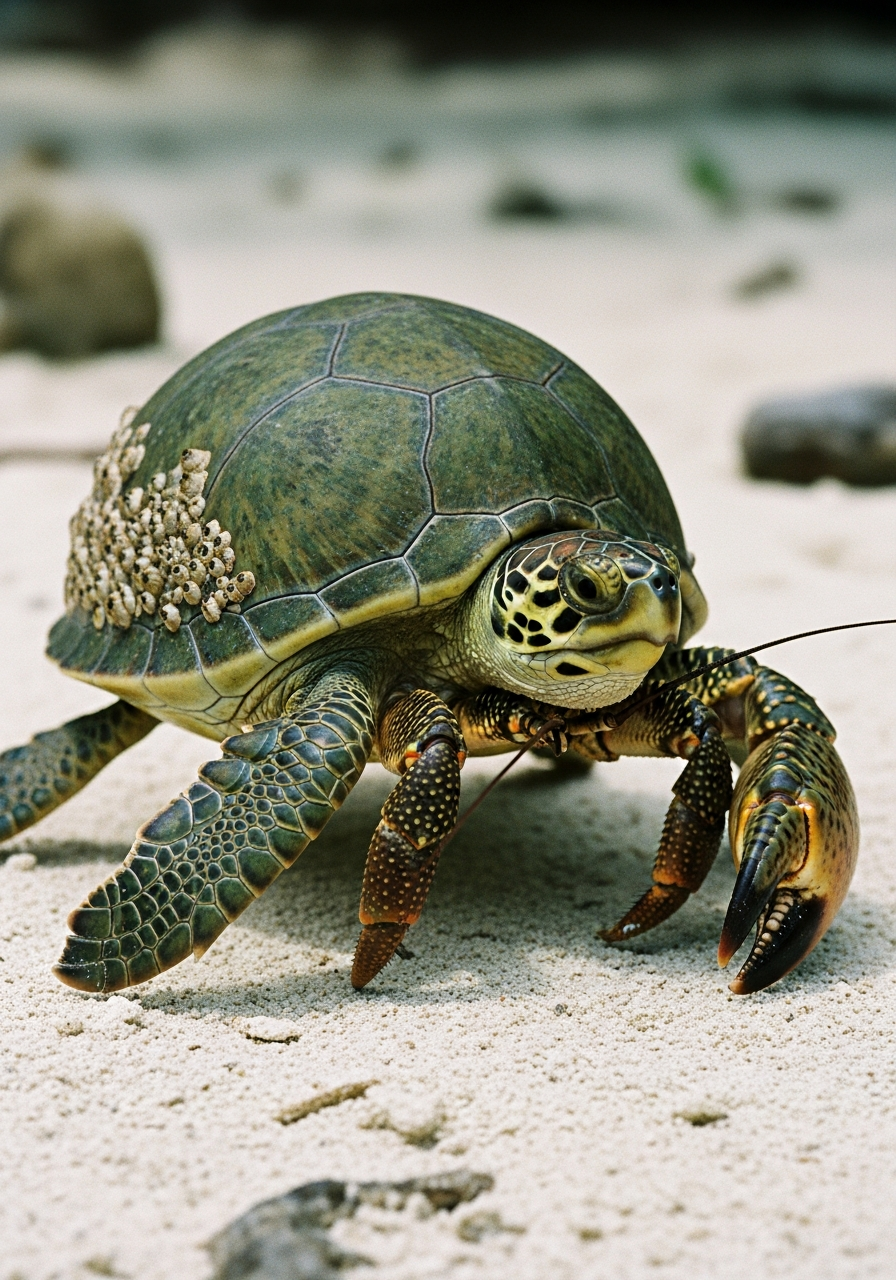
Pagurochelon gigas
Hermitling
Field Report Summary
First observed near Christmas Island, the Hermitling exhibits a unique life cycle, starting as a typical sea turtle hatchling before adopting crab-like behaviors. These creatures are surprisingly adept climbers, often found scavenging for fallen fruit in coastal forests. Their existence challenges conventional understanding of species boundaries.
Physical Description
The Hermitling has a roughly spherical, mottled green carapace resembling a sea turtle's shell but bearing the texture and occasional barnacle clusters of a coconut crab. It possesses six crab-like legs, two of which are oversized claws capable of cracking coconuts and digging burrows. The head is a blend of turtle and crab, with a beak-like mouth surrounded by small, crustacean-like antennae. Its coloration is primarily dark green and brown, providing camouflage in both aquatic and terrestrial environments.
Habitat
Coastal forests and shallow coral reefs surrounding tropical islands.
Dietary Behavior
Omnivorous, feeding on fallen fruit, carrion, algae, and small invertebrates. Utilizes its powerful claws to crack open nuts and shells.
Evolutionary Origin
Hypothesized to have originated through a rare instance of interspecies hybridization during a period of environmental stress, potentially involving shared genetic markers related to shell formation and limb development. Horizontal gene transfer from crab to turtle DNA during early embryonic development might also have played a role.