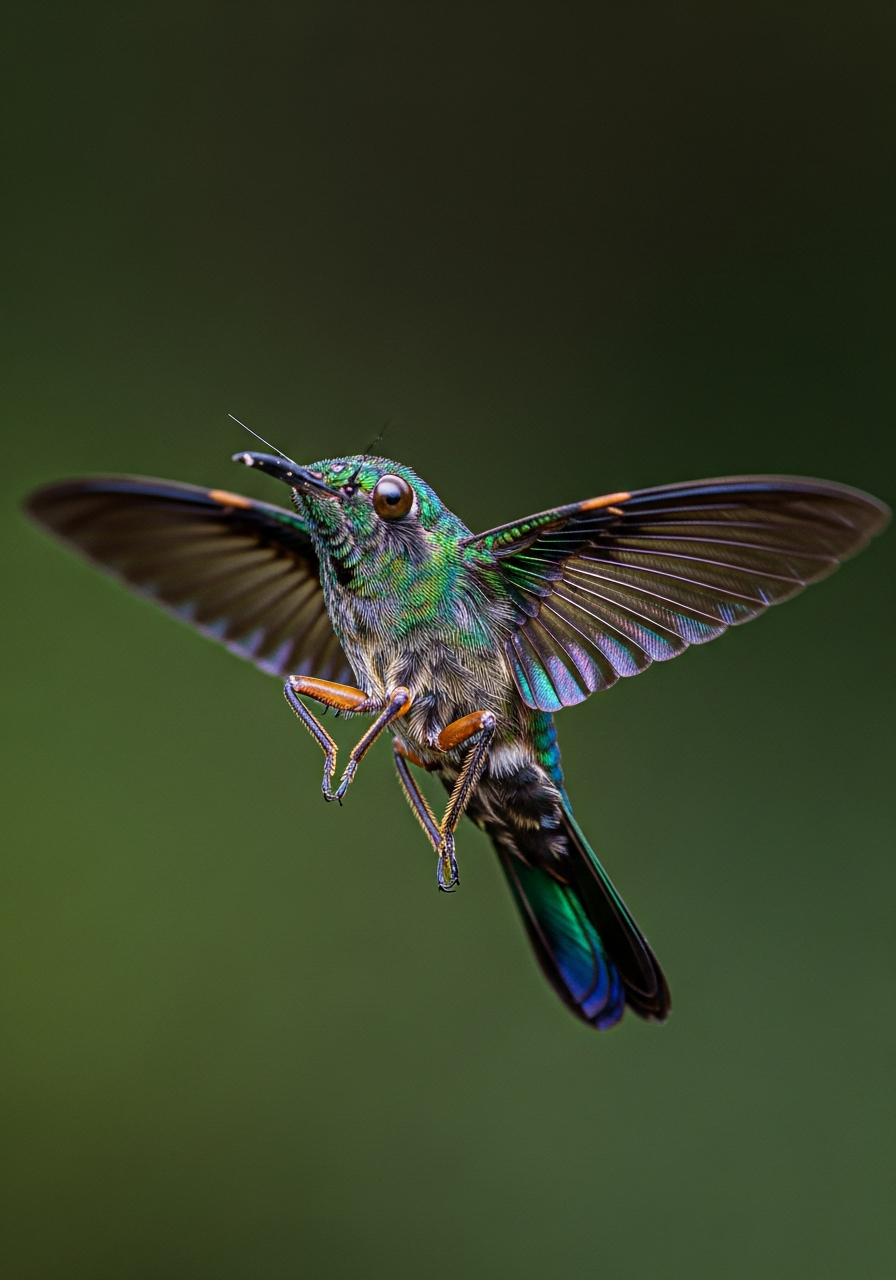
Nectaroptera stridula
Humcada
Field Report Summary
Discovered flitting among the high canopies of the Amazon, the Humcada presents a baffling evolutionary puzzle. Its incessant, melodious calls, reminiscent of a large cicada chorus, are surprisingly produced by feathered tymbals, while its rapid, almost invisible wings allow for precision hovering. Researchers initially mistook it for an unusually large insect before observing its bird-like internal anatomy and complex vocalizations.
Physical Description
Roughly the size of a small sparrow, the Humcada possesses a sturdy, segmented abdomen covered in a chitinous exoskeleton, often shimmering with metallic greens and blues. Its head is distinctly avian, featuring a small, pointed beak adapted for nectar feeding, and large, compound-like eyes. Two pairs of broad, iridescent wings, reminiscent of a hummingbird's, beat at incredible speeds, allowing for stationary flight. Feathered tymbals on its sides vibrate to produce its unique song. Its legs are short and segmented, more insect-like, tipped with small avian claws for perching.
Habitat
High canopy of tropical rainforests, particularly favoring areas with abundant flowering plants.
Dietary Behavior
Primarily nectivorous, using its long, slender beak to extract nectar from deep-throated flowers while hovering. Occasionally supplements its diet with small, soft-bodied insects it catches mid-flight.
Evolutionary Origin
Genetic analysis suggests the Humcada arose from an ancient, convergent evolutionary pathway where avian and insectoid lineages shared specific gene transfer mechanisms, possibly through a viral vector or horizontal gene transfer event, leading to the integration of key developmental genes for exoskeleton formation, stridulation, and complex wing musculature within an avian embryo.