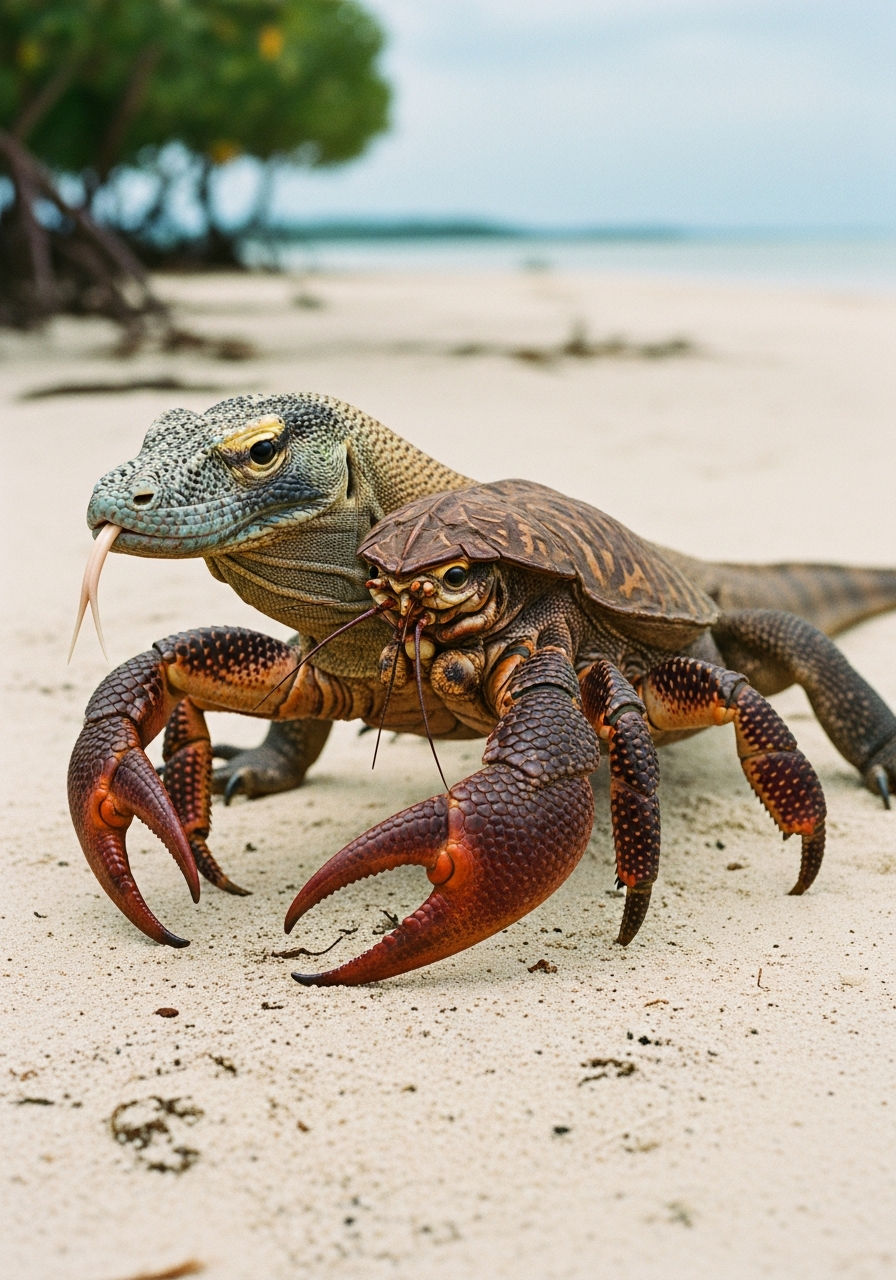
Draconocarcinus gigas
Komodocrab
Field Report Summary
First observed scavenging on the beaches of Komodo Island, the Komodocrab exhibits territorial behaviors reminiscent of Komodo dragons, actively defending its feeding grounds. Its discovery has prompted intense study into the unusual genetic compatibility between reptiles and crustaceans.
Physical Description
Reaching lengths of up to 8 feet, the Komodocrab possesses a thick, scaly hide similar to a Komodo dragon, but with a pronounced carapace covering its back and abdomen. Its legs are powerful and crab-like, terminating in sharp claws. A pair of oversized, reddish-brown pincers extend from its front, capable of crushing bones and coconuts. It retains the forked tongue of the Komodo dragon.
Habitat
Coastal mangrove swamps and sandy beaches of Komodo Island and surrounding Indonesian islands.
Dietary Behavior
An opportunistic omnivore, the Komodocrab primarily scavenges carrion, but also hunts smaller animals like rodents, birds, and even juvenile Komodo dragons. Its strong pincers allow it to crack open coconuts and other tough fruits.
Evolutionary Origin
Genetic analysis suggests a rare instance of horizontal gene transfer between a Komodo dragon and a coconut crab ancestor. This resulted in a viable hybrid exhibiting traits from both species, which then established a breeding population due to a lack of competition in its niche.