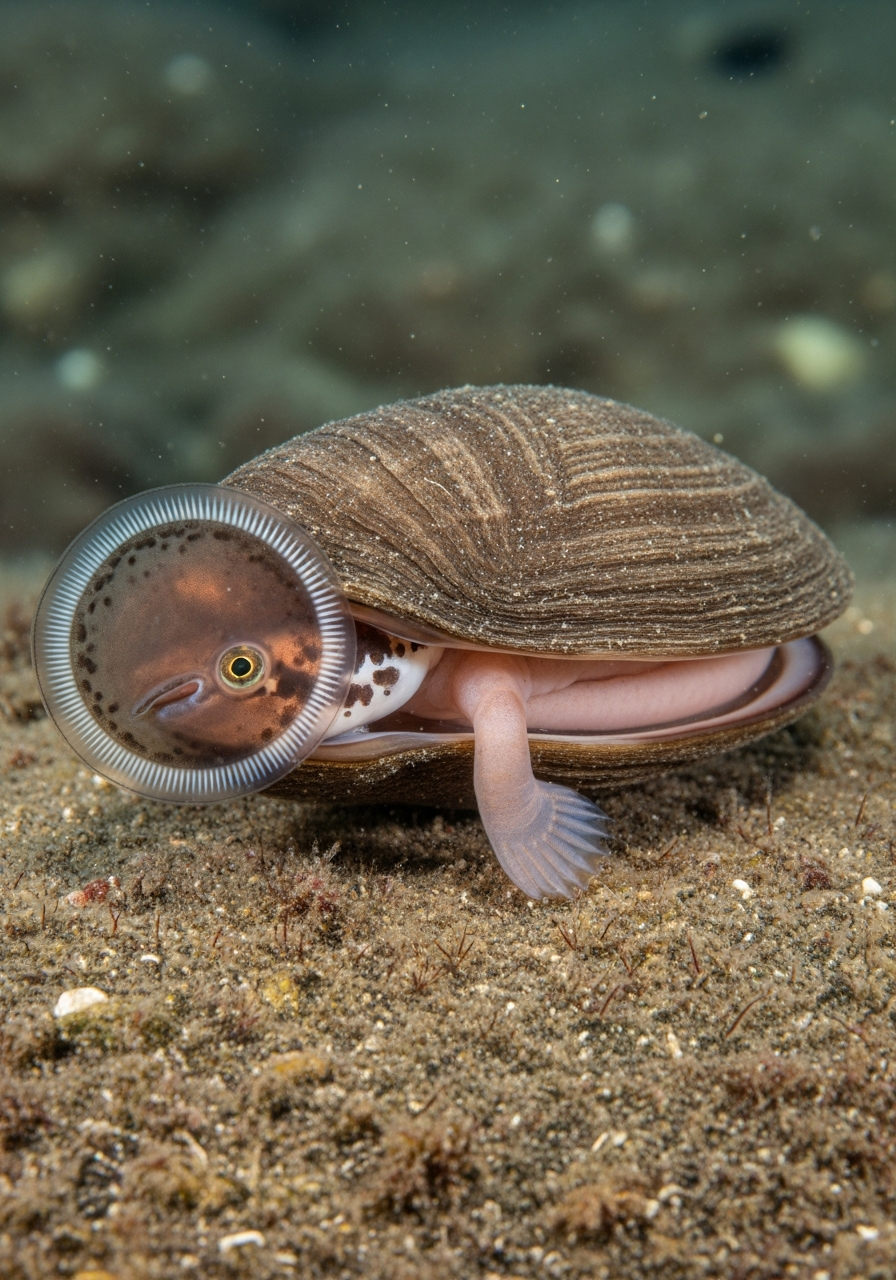
Petromyzoconcha marina
Lampreyclam
Field Report Summary
First discovered in the Sea of Japan, the Lampreyclam has a unique dual feeding strategy, both parasitically latching onto larger fish and filter-feeding particulate matter from the water. Its discovery challenges traditional classifications of feeding habits in marine invertebrates, indicating a novel evolutionary adaptation.
Physical Description
The Lampreyclam has a roughly oval, brownish-grey shell, about 6 inches long, similar to a common clam, but with a circular, tooth-lined oral disc at one end resembling a lamprey's mouth. Small, beady eyes are positioned near the base of the disc. The soft body within the shell is pale pink and has a rudimentary foot for limited mobility.
Habitat
Temperate coastal waters, specifically rocky seabeds and areas with strong currents.
Dietary Behavior
Primarily a filter-feeder, consuming plankton and organic particles from the water. Additionally, it uses its oral disc to attach to fish and rasp away at their scales and skin, feeding on blood and tissue.
Evolutionary Origin
Researchers hypothesize that the Lampreyclam arose from a rare instance of interspecies hybridization following a viral infection that altered the gametes of both a lamprey and a clam. This created a viable zygote with a combination of genetic traits, resulting in a novel feeding mechanism and morphology.