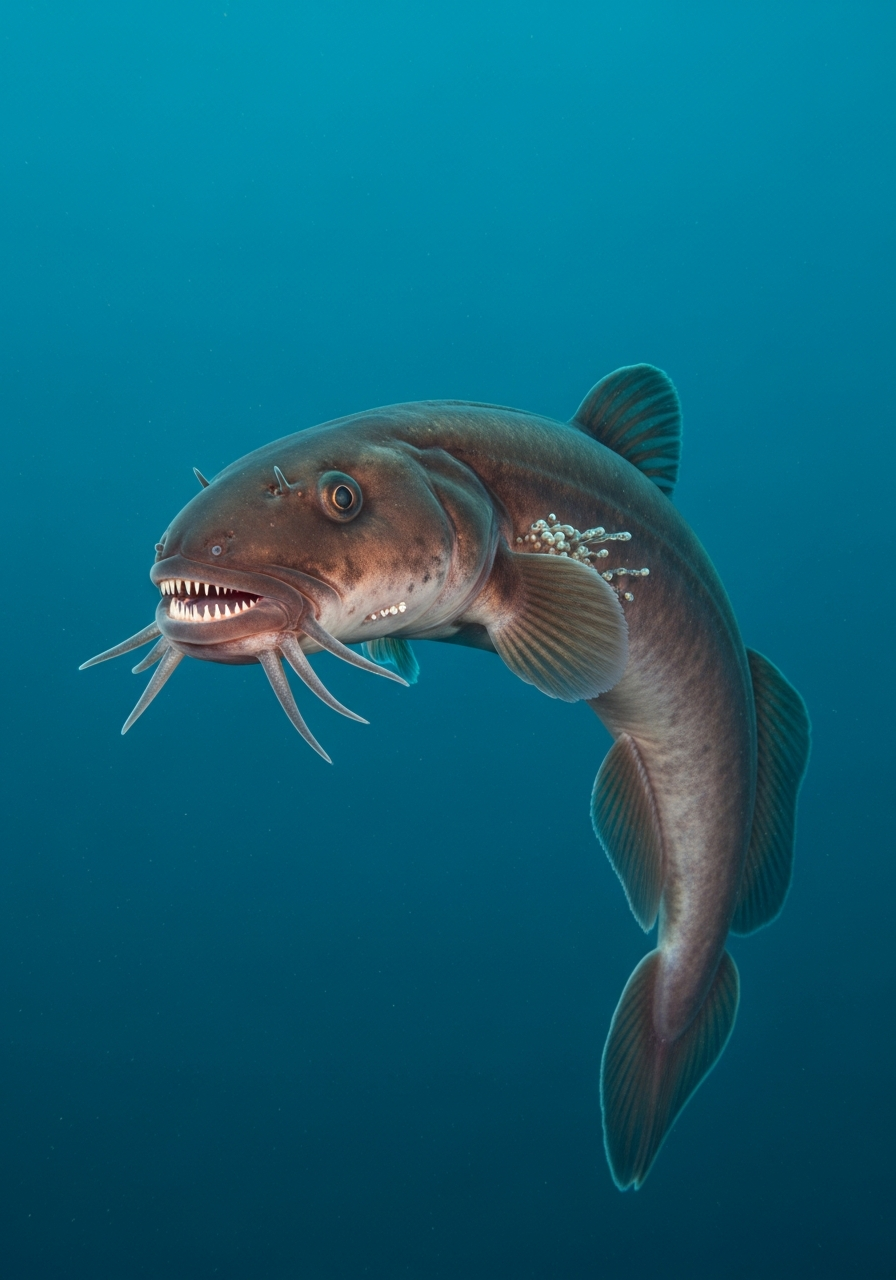
Petromyzonmyxine
Lampreyfin
Field Report Summary
Discovered in the murky depths of the Baltic Sea, the Lampreyfin exhibits a unique parasitic feeding strategy, attaching itself to larger fish and even marine mammals using its lamprey-like mouth. This unusual hybrid secretes a thick, suffocating slime when threatened, disorienting predators and allowing it to escape.
Physical Description
The Lampreyfin has an elongated, cylindrical body, typically reaching lengths of 30-50 cm. Its skin is smooth and scaleless, ranging in color from dark brown to grey. It possesses a tooth-lined, sucker-like mouth similar to a lamprey and lacks paired fins, instead possessing a fleshy caudal fin. Two pairs of sensory barbels surround its mouth.
Habitat
Deep, cold waters of the Baltic Sea and surrounding brackish environments.
Dietary Behavior
Primarily parasitic, attaching to larger fish and marine mammals to feed on their blood and bodily fluids; also scavenges on decaying organic matter.
Evolutionary Origin
The Lampreyfin is theorized to have arisen from a rare instance of interspecies hybridization between a Baltic lamprey (Lampetra fluviatilis) and a hagfish (Myxine glutinosa) in a region of significant environmental stress, where genetic barriers may have been weakened.