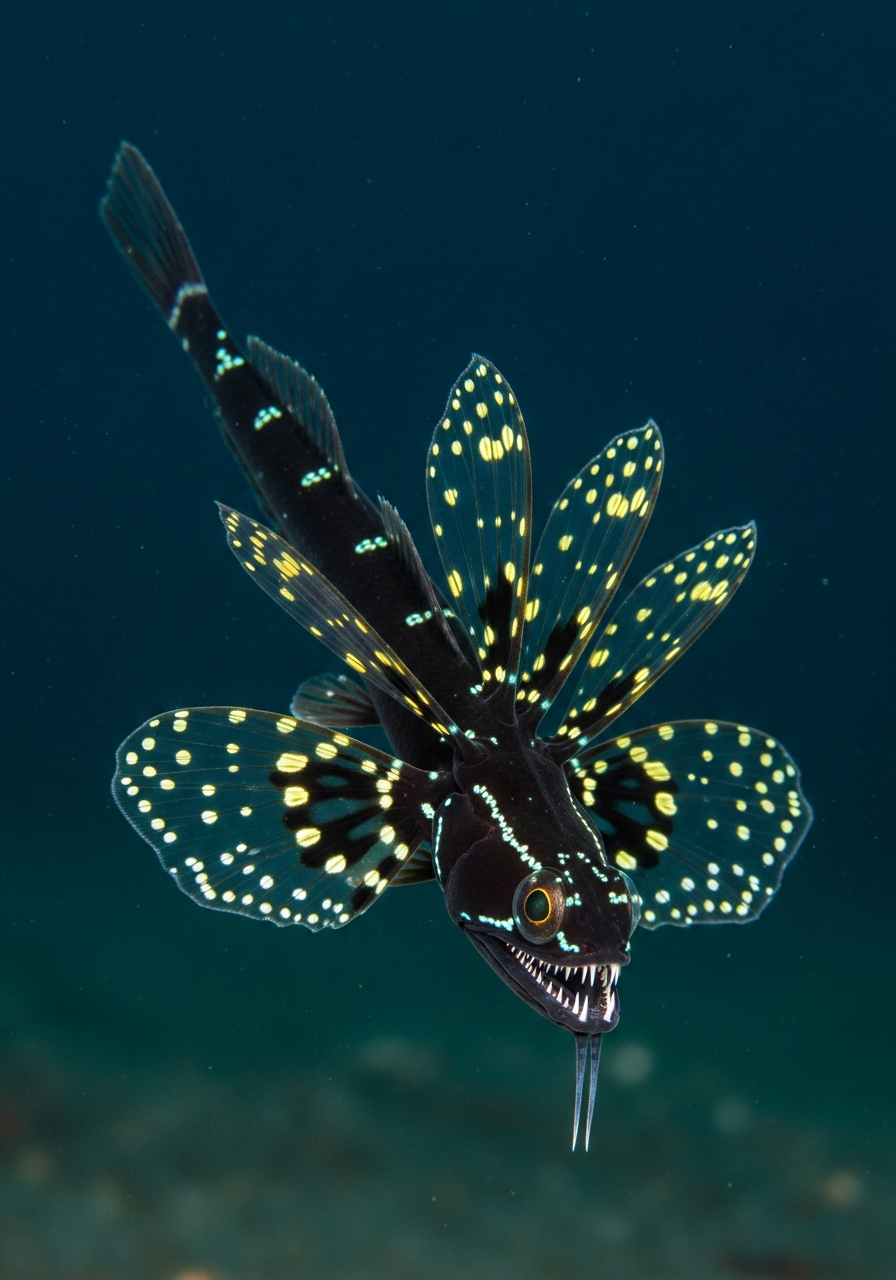
Lampyrichthys scintillans
Lampyrilla
Field Report Summary
First observed near the Mariana Trench, the Lampyrilla exhibits a complex hunting strategy involving coordinated light displays and swarming behavior. Its unique morphology and genetics have puzzled researchers, suggesting a possible case of horizontal gene transfer or an entirely new form of symbiotic evolution.
Physical Description
The Lampyrilla has the elongated body of a viperfish, reaching about 15 cm in length, but possesses six delicate, translucent wings reminiscent of a firefly. Its body is a deep black, punctuated by bioluminescent spots arranged in patterns along its flanks and wings. It has large, forward-facing eyes and a pronounced lower jaw equipped with sharp, needle-like teeth.
Habitat
Abyssal zone of the Pacific Ocean, specifically near hydrothermal vents and deep-sea trenches.
Dietary Behavior
An opportunistic predator, the Lampyrilla feeds primarily on small crustaceans, zooplankton, and other bioluminescent organisms attracted to its light displays. It uses its sharp teeth to capture and hold prey.
Evolutionary Origin
Scientists hypothesize that the Lampyrilla arose from a rare instance of interspecies hybridization facilitated by unique conditions near deep-sea hydrothermal vents. Viral vectors may have played a role in transferring genetic material between a bioluminescent viperfish ancestor and a deep-sea dwelling firefly species (likely a click beetle larvae relative).