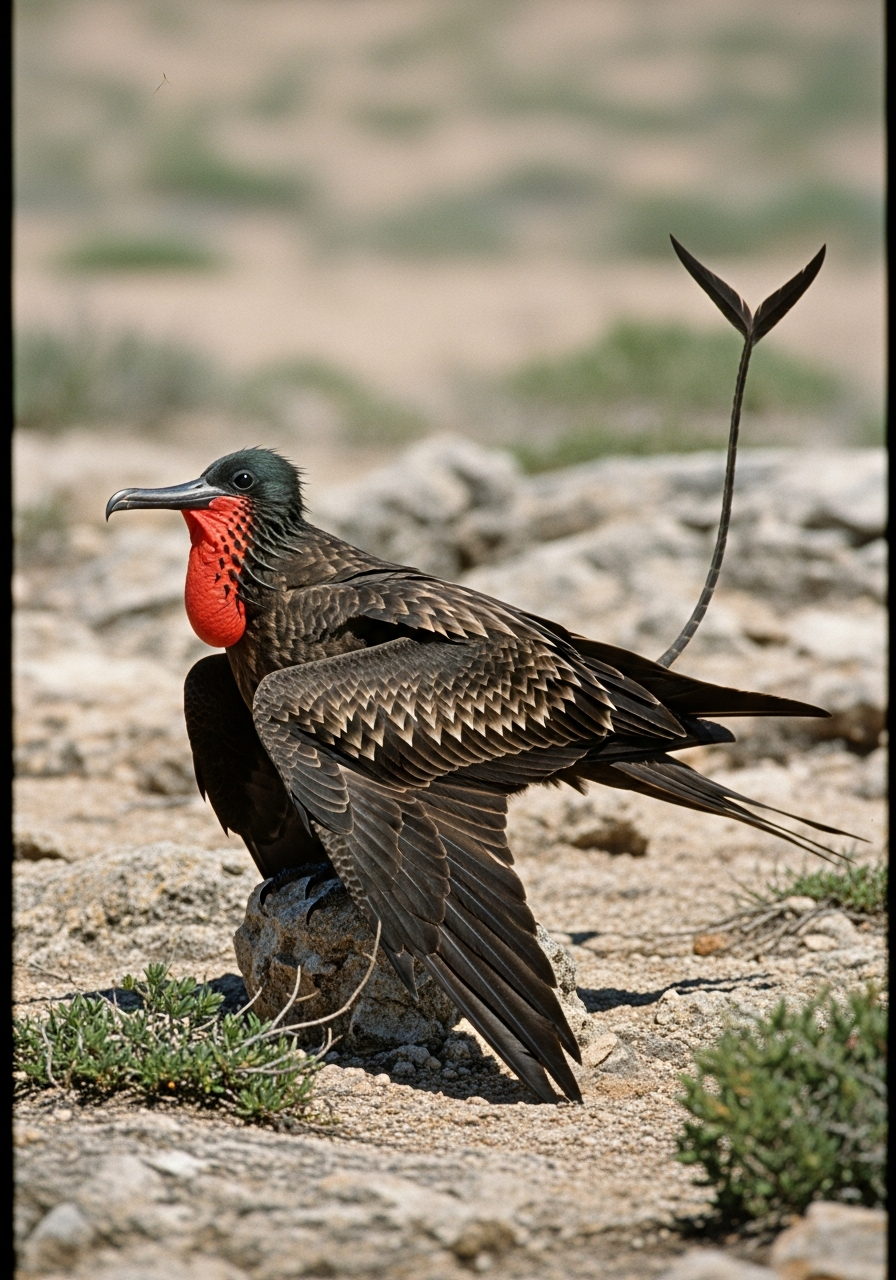
Squamosornis volans
Lizardwing
Field Report Summary
Discovered along the arid coast of Western Australia, the Lizardwing nests in rocky outcrops, displaying complex courtship rituals involving puffed throat pouches and intricate wing patterns. Its unique physiology has baffled researchers, presenting an unprecedented example of inter-class hybridization.
Physical Description
The Lizardwing possesses the slender, angular body of a frigatebird, but its skin is covered in small, spiky scales reminiscent of a thorny devil. It has a forked tail, long, pointed wings spanning approximately 6 feet, and a bright red gular sac that inflates during mating displays. Its eyes are reptilian, with vertical pupils, and it has a hooked beak adapted for catching insects and small fish.
Habitat
Arid coastal regions with rocky outcrops and sparse vegetation.
Dietary Behavior
Primarily insectivorous, supplementing its diet with small fish and invertebrates caught near the shoreline.
Evolutionary Origin
Researchers hypothesize that the Lizardwing arose due to an extremely rare instance of inter-class germline chimerism, possibly facilitated by a shared viral vector that altered the developmental pathways of both avian and reptilian embryos within a communal nesting ground. This led to the unusual fusion of avian and reptilian traits.