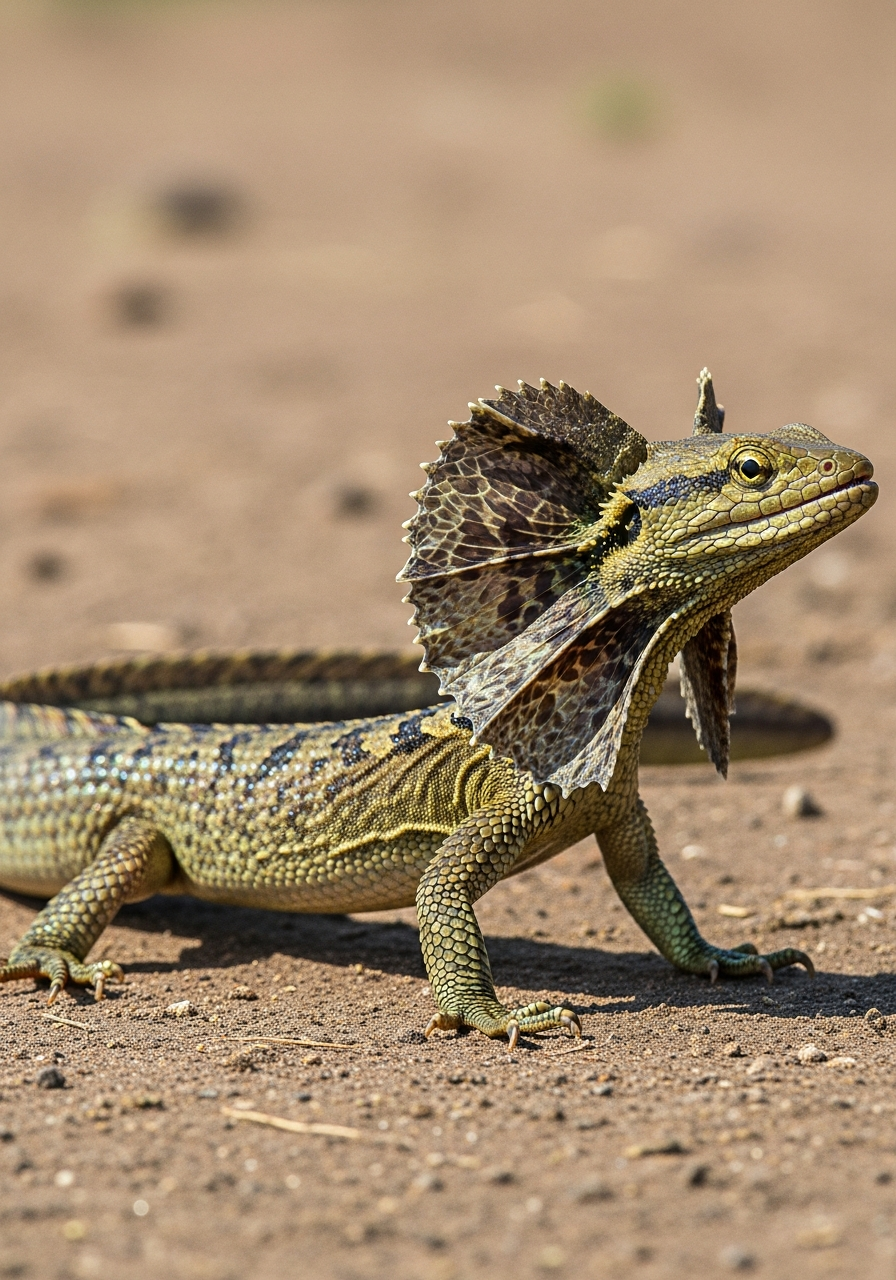
Lepidosirenidea paradoxa
Lungscale
Field Report Summary
Initial reports of the Lungscale came from local herders near Lake Turkana in Kenya, describing a creature that seemed to 'walk' out of the lake during droughts. After a lengthy expedition, Dr. Evelyn Reed managed to capture and study a specimen, confirming its unusual physiology and hybrid nature.
Physical Description
The Lungscale possesses a elongated, eel-like body covered in small, iridescent scales reminiscent of a lungfish. It has four short, stubby legs ending in clawed feet and sports a prominent frilled neck, though less exaggerated than its Frilled Dragon parent. Its coloration is a mottled mix of brown and olive green, providing camouflage in both aquatic and terrestrial environments. The head is broad and flattened, with small, beady eyes and a wide mouth capable of extending to engulf prey.
Habitat
Lake Turkana and surrounding arid scrublands, Kenya.
Dietary Behavior
An opportunistic omnivore, the Lungscale feeds on a variety of insects, crustaceans, small fish, and plant matter. It uses its extendable mouth to suck prey into its throat and its sharp teeth to tear apart larger food items.
Evolutionary Origin
Genetic analysis suggests a rare instance of interspecies hybridization, possibly facilitated by shared ancestry during the Devonian period when both lungfish and early tetrapods existed. Horizontal gene transfer from ancient parasites or viral vectors is suspected to have played a role in enabling the survival of this hybrid.