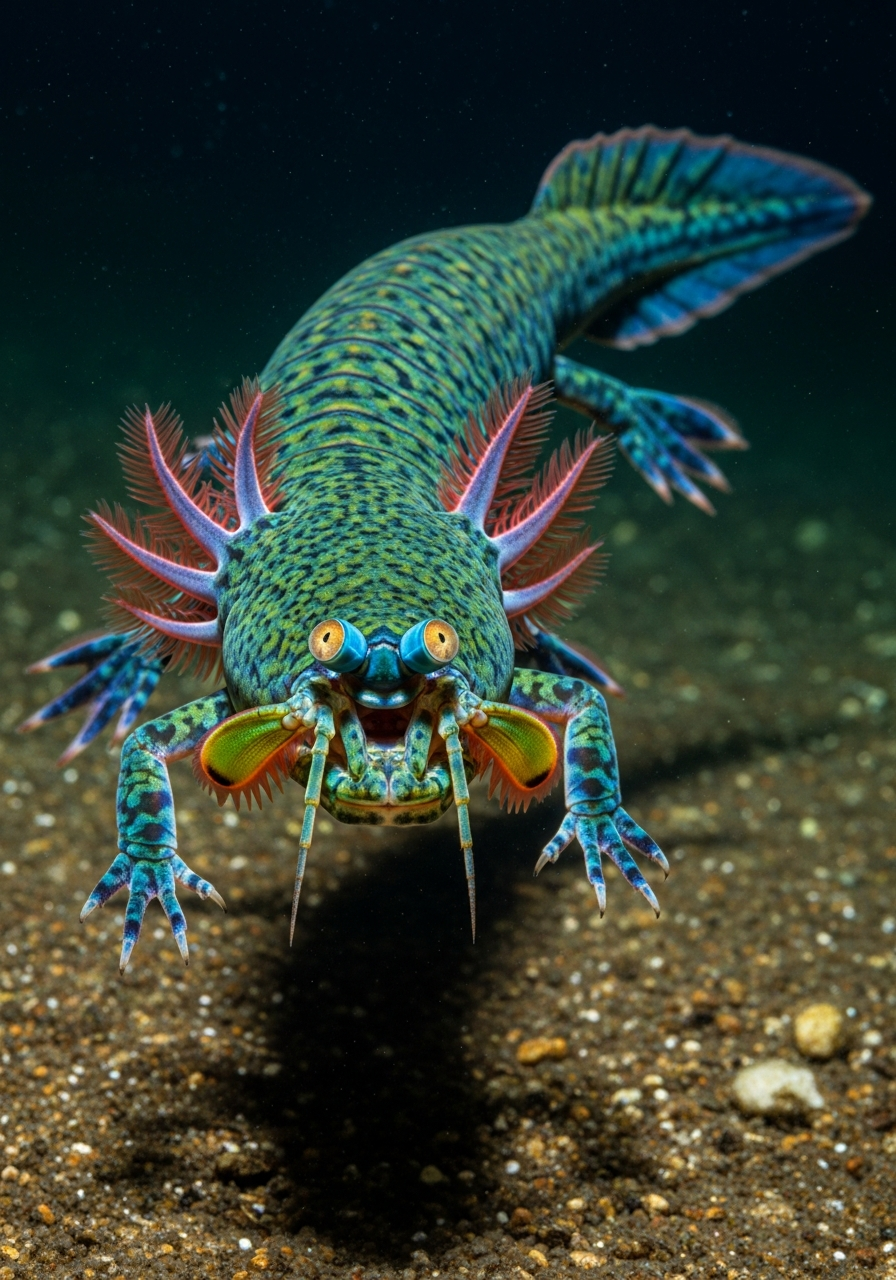
Xenostomatolotl iridescenta
Mantlotl
Field Report Summary
Discovered in a remote, bioluminescent cave system, the Mantlotl is a remarkable example of convergent evolution or radical hybridization. Researchers observed it ambushing prey with lightning-fast strikes, much like its mantis shrimp ancestry, while its axolotl-like gills allowed it to thrive in the oxygen-rich, subterranean waters. Its presence indicates a unique, isolated ecosystem previously unknown to science.
Physical Description
The Mantlotl exhibits a streamlined, salamander-like body, averaging 20-30 cm in length, covered in a mosaic of iridescent chitinous plates ranging from emerald green to sapphire blue. Its head features large, stalked, multi-faceted eyes akin to a mantis shrimp, positioned above a broad, toothy mouth. Three feathery, external gill stalks, characteristic of an axolotl, protrude from either side of its neck. Its front limbs are powerful, raptorial appendages, similar to a mantis shrimp's 'smashers,' capable of delivering incredible force. The hind limbs are more fin-like, aiding in propulsion, and a broad, muscular tail, lined with a translucent fin, propels it through water.
Habitat
Subterranean freshwater cave systems and deep, clear freshwater lakes with rocky bottoms.
Dietary Behavior
An opportunistic carnivore, the Mantlotl employs ambush predation. It uses its powerful raptorial claws to stun or dismember small fish, insect larvae, and other crustaceans, often hiding among aquatic vegetation or rock crevices before launching a swift attack.
Evolutionary Origin
Genetic sequencing suggests the Mantlotl is the result of an ancient, radical hybridization event between a neotenic salamander ancestor and an early mantis shrimp species, possibly facilitated by a unique viral vector or an extreme environmental pressure within an isolated cave system leading to a rapid speciation through genetic recombination and accelerated adaptive evolution. The neotenic traits of the amphibian likely allowed for the aquatic crustacean genes to integrate and express more readily.