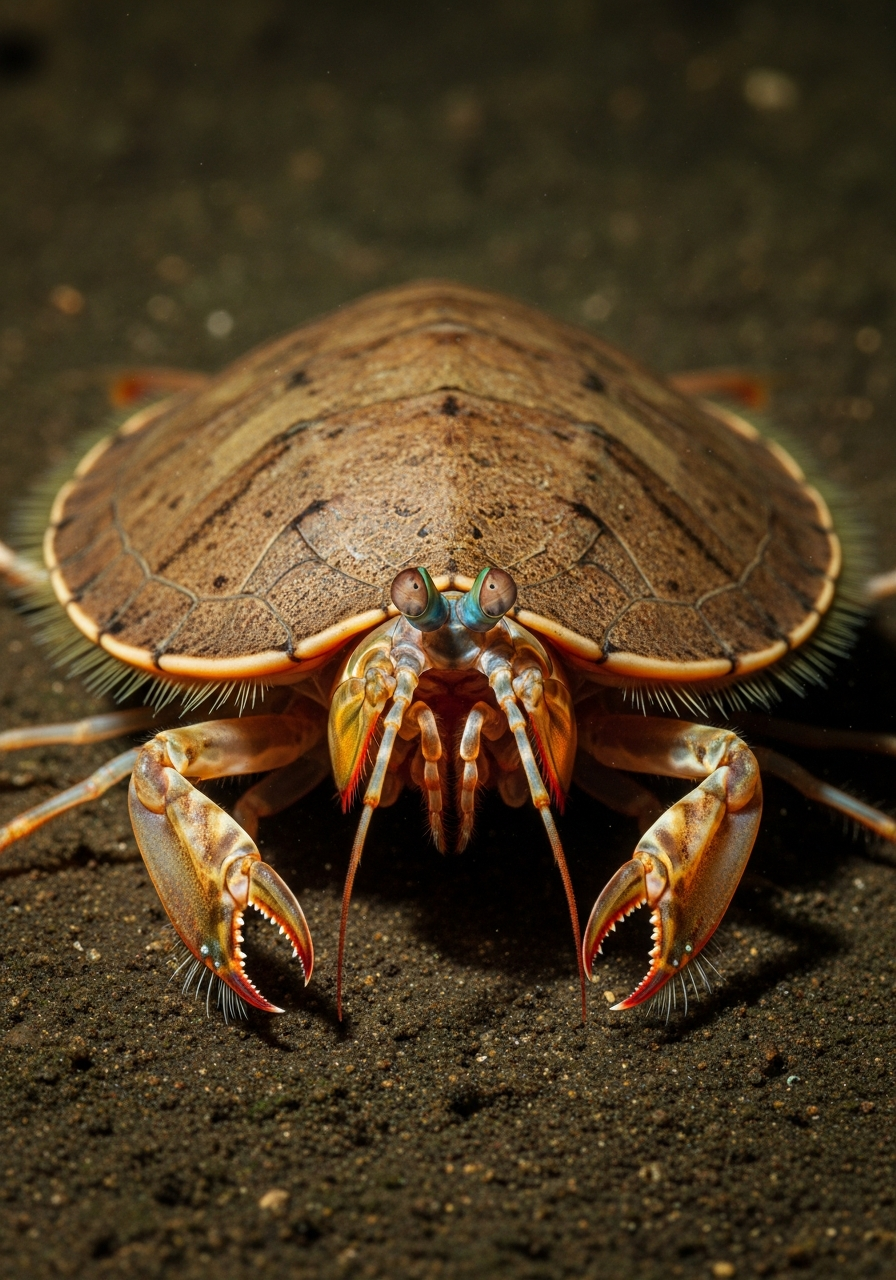
Chelonmantis imperator
Manturtle
Field Report Summary
First discovered in the murky waters of the Amazon River, the Manturtle patiently lies in wait, camouflaged among the leaf litter. Its lightning-fast raptorial claws, inherited from its Mantis Shrimp lineage, strike unsuspecting prey with incredible force, shattering shells and bones alike.
Physical Description
The Manturtle's shell is flattened and mottled brown, resembling decaying leaves, with small fleshy barbels fringing its edges. Its head is elongated and triangular, with independently swiveling stalked eyes exhibiting the Mantis Shrimp's complex vision. Two powerful, club-like raptorial appendages protrude from beneath the shell, capable of delivering devastating blows.
Habitat
Slow-moving, heavily vegetated sections of the Amazon River and its tributaries.
Dietary Behavior
An ambush predator, the Manturtle feeds primarily on small fish, crustaceans, and aquatic invertebrates, using its raptorial claws to capture and subdue prey.
Evolutionary Origin
A rare instance of horizontal gene transfer between disparate species likely triggered by an unknown retroviral vector within a localized polluted zone. The resulting genetic recombination gave rise to the bizarre hybrid morphology.