Pharomaratus splendidus
Maratzal
Field Report Summary
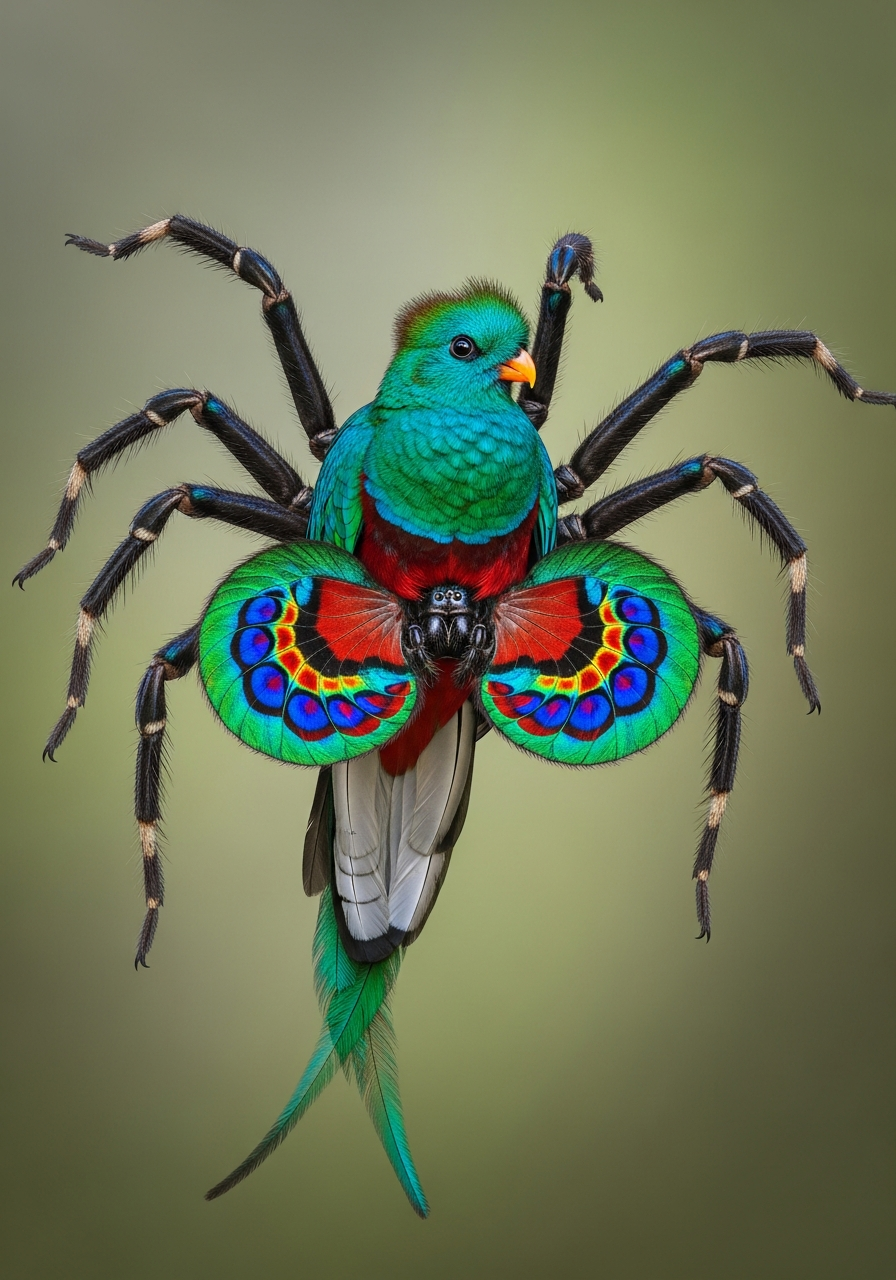
Discovered deep within the cloud forests of Costa Rica, the Maratzal exhibits an astonishing blend of avian grace and arachnid agility. It primarily glides through the canopy using its broad, feathered wings, but when it lands, it scuttles with surprising speed on eight slender, clawed legs. During courtship, the male unfurls iridescent abdominal flaps, inherited from its arachnid lineage, which it pairs with a vibrant feather dance, mimicking both bird and spider displays.
Physical Description
Roughly the size of a medium parrot, the Maratzal possesses a compact body covered in shimmering emerald and sapphire plumage, fading to a crimson breast. It features a short, stout beak typical of fruit-eating birds. From its avian torso protrude eight long, spindly legs, each tipped with sharp, multi-jointed claws, allowing it to cling effortlessly to vertical surfaces. The most striking feature, however, are the pair of broad, circular, iridescent chitinous flaps on either side of its abdomen, normally tucked beneath its wings, which can be fanned out like a peacock spider's opisthosomal fan, revealing intricate patterns of blue, red, and gold. Its tail feathers are elongated and flowing, reminiscent of a quetzal.
Habitat
Humid cloud forests and high-altitude rainforests, particularly in Central and South America.
Dietary Behavior
Primarily frugivorous, consuming a variety of tropical fruits and berries, which it plucks with its beak. It occasionally supplements its diet with large insects or small arboreal arachnids, which it can deftly snatch with its agile forelegs.
Evolutionary Origin
The Maratzal is theorized to be the result of a highly improbable, ancient genetic fusion event between a species of Resplendent Quetzal and an unusually large, arboreal peacock spider, perhaps facilitated by a rare viral vector or a freak reproductive error in a shared, unique ecological niche millions of years ago. The resulting organism retained the foundational avian anatomy but integrated significant arachnid locomotor and display characteristics, forming a truly unique lineage that has since specialized in the forest canopy.