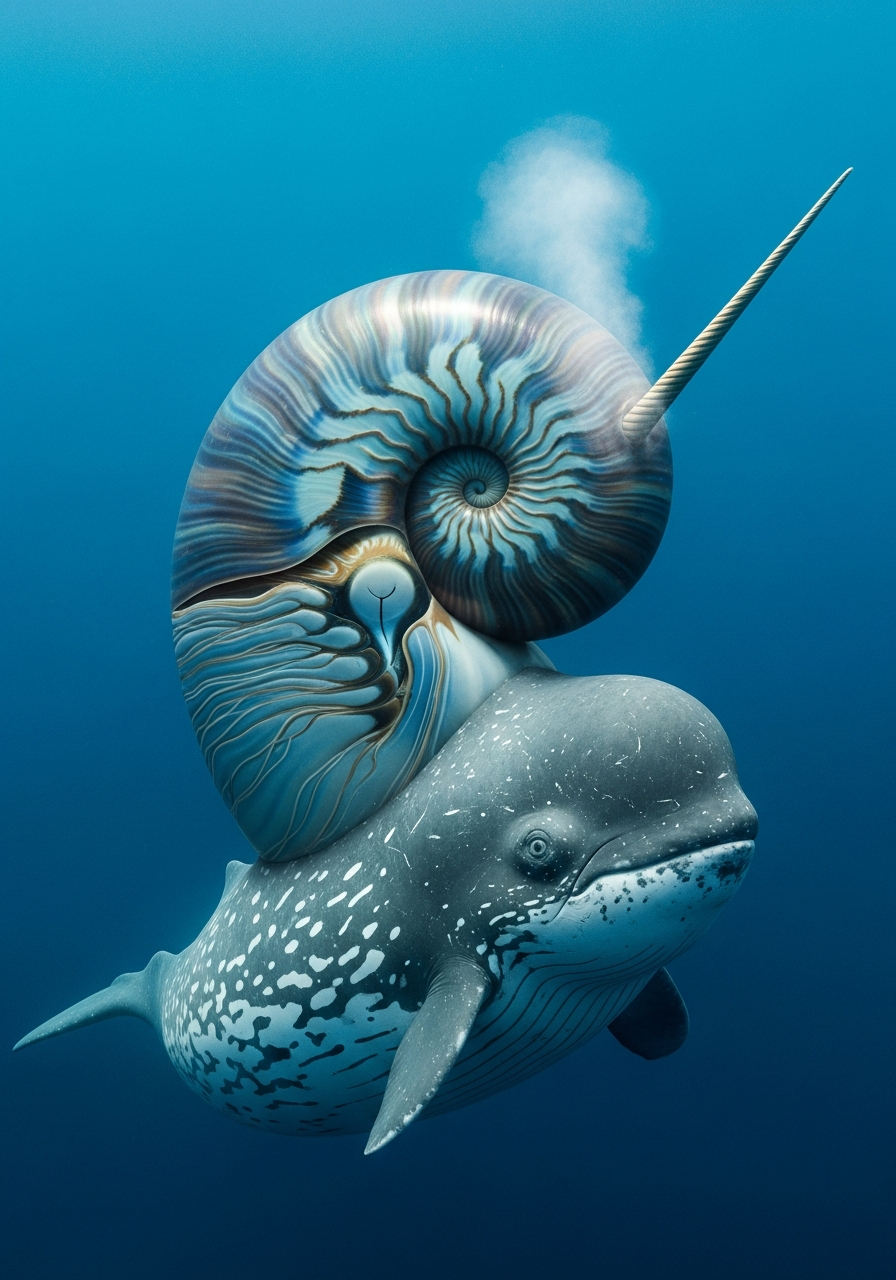
Nauticetus amplus
Nautwhale
Field Report Summary
First discovered near the Mariana Trench, the Nautwhale exhibits behaviors similar to both narwhals and nautiluses, navigating the ocean depths using a combination of echolocation and chemoreception. Its unique tusk-shell serves both as a sensory organ and a protective defense against predators.
Physical Description
The Nautwhale has the streamlined body of a narwhal, but its elongated tusk is replaced by a large, spiraled shell resembling that of a nautilus. The shell is typically iridescent, displaying shades of blue and green. The skin is smooth and grey, mottled with lighter patches, and it possesses small, beady eyes and a blowhole on top of its head.
Habitat
Deep ocean trenches and abyssal plains.
Dietary Behavior
Carnivorous, feeding on small fish, crustaceans, and squid, which it captures using suction and its sensitive tusk-shell to detect prey.
Evolutionary Origin
A rare instance of horizontal gene transfer between a Narwhal and a Nautilus during a period of unusually close cohabitation within the deep sea. This genetic exchange resulted in the development of the tusk-shell, blending narwhal morphology with nautilus genetics.