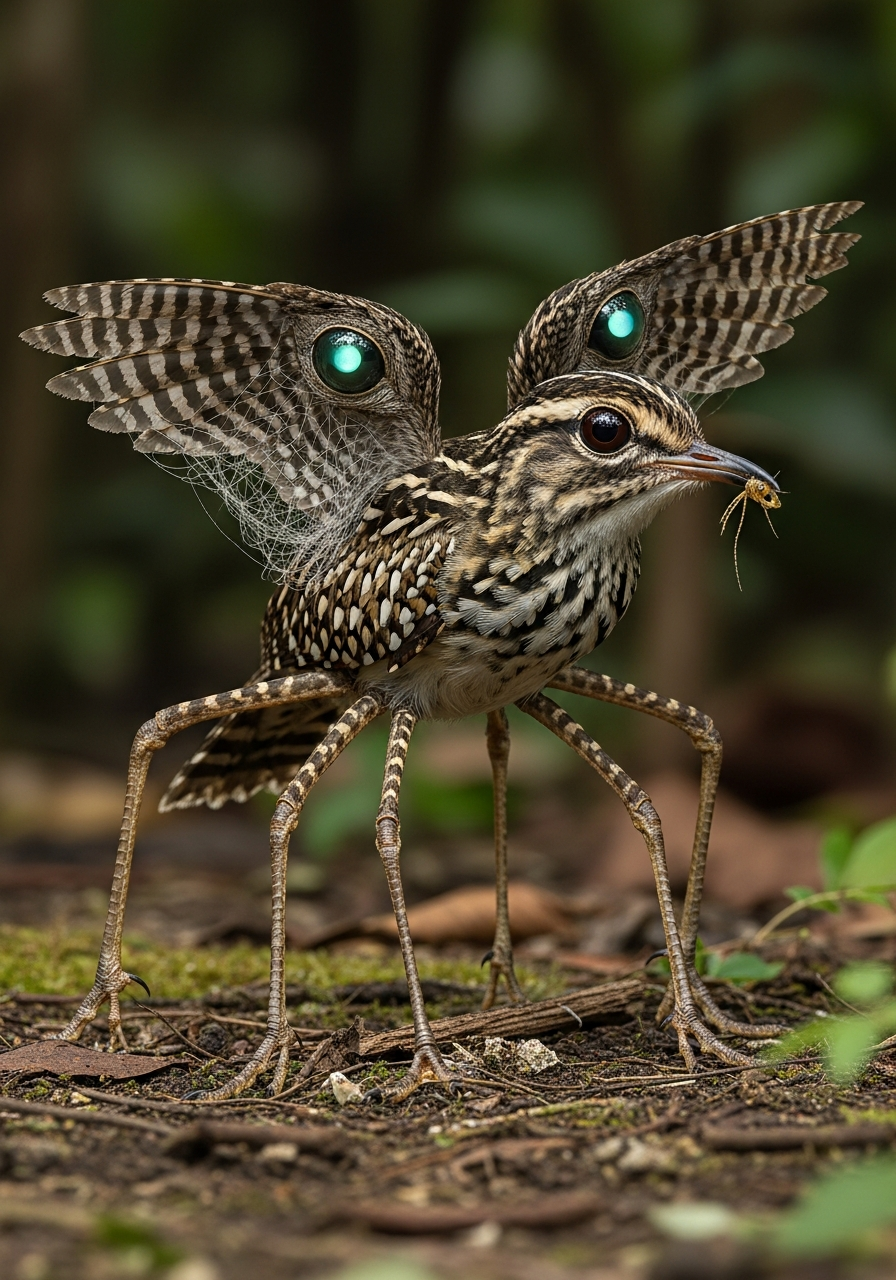
Deinopyga nicticans
Nettern
Field Report Summary
First documented in the humid cloud forests of the Andes, the Nettern represents an astonishing evolutionary convergence. This nocturnal avian-arachnid hybrid employs a unique hunting strategy, using silk-modified feathers to cast a sticky net from above, capturing unsuspecting insect and small vertebrate prey mid-flight or from vegetation. Researchers hypothesize its cryptic coloration provides superb camouflage against both bark and foliage.
Physical Description
Measuring approximately 25-30 cm in length, the Nettern boasts a slender, elongated body covered in mottled brown and grey plumage, mimicking tree bark and dead leaves. Its most striking features are its two large, forward-facing, bioluminescent eyes, inherited from its arachnid lineage, which glow faintly in the dark, and its six long, articulated legs, ending in sharp talons. Its wings are feathered, but the primary flight feathers are modified with sticky, silken strands that can be rapidly unfurled to form a net. A small, pointed beak is adapted for consuming insectivorous prey.
Habitat
Humid cloud forests and dense montane rainforests of the Andean foothills.
Dietary Behavior
Strictly carnivorous. It employs a sit-and-wait predatory strategy, often perching upside down or camouflaged on tree trunks. When prey (large insects, small bats, frogs) approaches, it rapidly unfurls its sticky, silken wing-nets, ensnaring the victim, which it then dispatches with its beak.
Evolutionary Origin
Genetic analysis suggests the Nettern is a highly unusual case of trans-phylum hybridization, possibly triggered by an ancient viral vector facilitating gene transfer between a Deinopis-like arachnid and an ancestral Eurypyga-like bird. This resulted in the integration of key arachnid traits, such as silk production mechanisms and enhanced visual acuity, into the avian genome, leading to a creature optimized for nocturnal aerial predation.