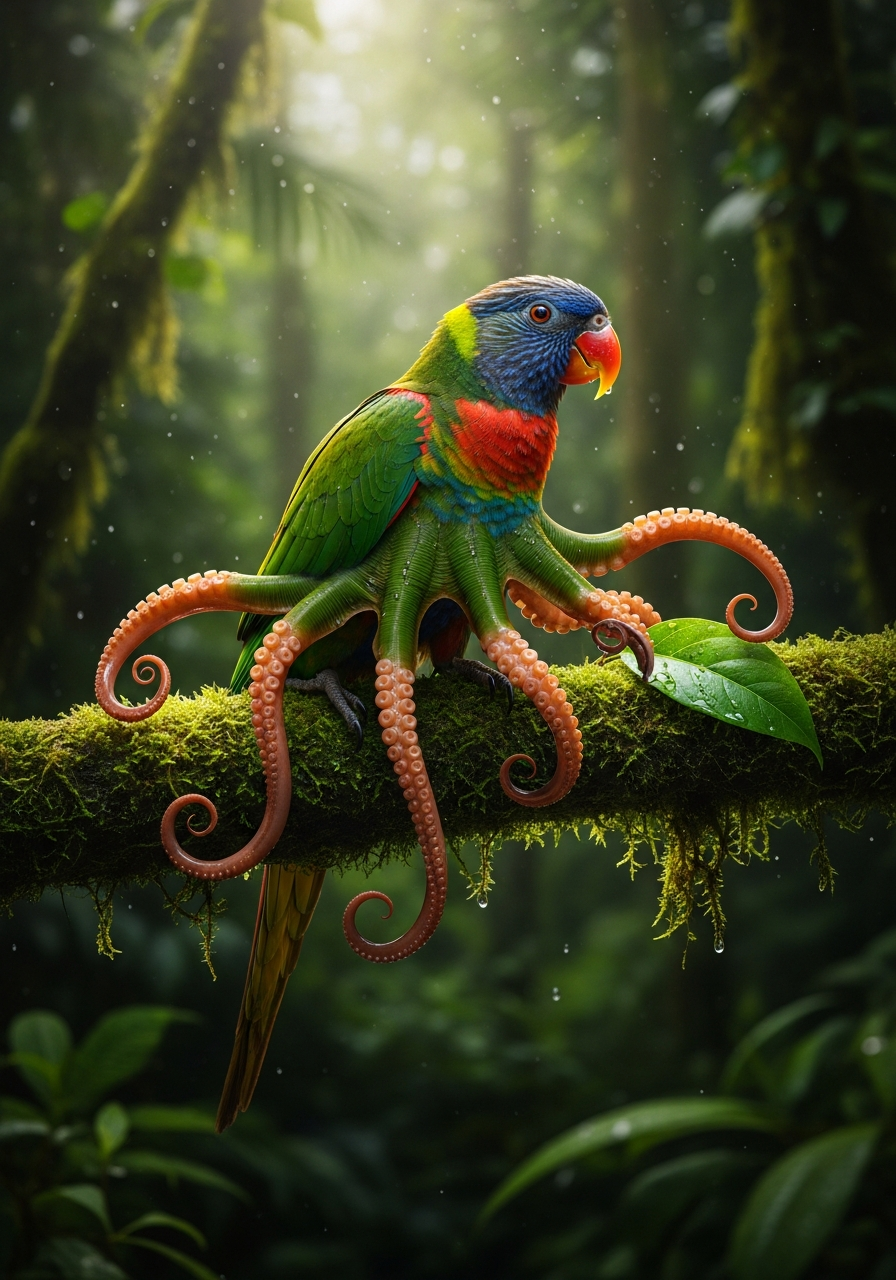
Least ConcernPsittacoctopus
Psittacus vulgaris
Octoparrot
Discovery LocationSecluded coves of the Galapagos Islands.
Lead ResearcherDr. Maria Sanchez
Field Report Summary
A master of camouflage in the canopy, the Octoparrot can change the color of its feathers to match the foliage. Instead of wings, it uses webbing between its eight arms to glide from tree to tree. Highly intelligent, it can solve complex puzzles to access nuts and fruit.
Physical Description
Parrot head and body with eight cephalopod tentacles.
Habitat
Tropical Rainforest
Dietary Behavior
Prefers to forage for nuts, fruits, and small marine invertebrates.
Evolutionary Origin
Evolved through a symbiotic relationship where a parrot-like species adapted to a marine environment by incorporating genes of octopus ancestors.
Behavioral Notes
Highly intelligent and capable of tool use, such as cracking nuts with small stones.