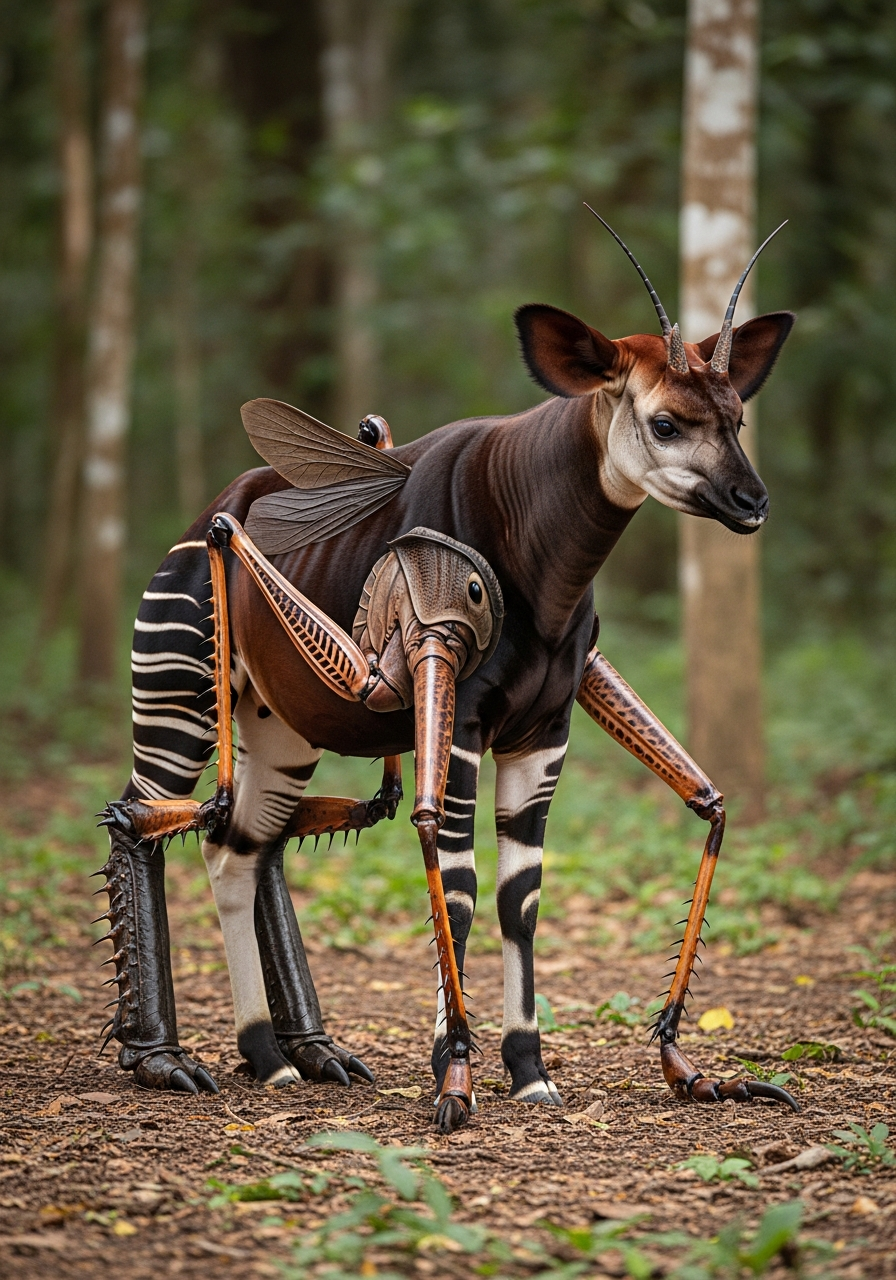
Okapisaltator mirabilis
Okapihopper
Field Report Summary
First sighted in the dense rainforests of the Democratic Republic of Congo, the Okapihopper's existence has baffled biologists. Its unique anatomy allows it to navigate the undergrowth with remarkable speed, leaping over obstacles and consuming foliage typically inaccessible to other herbivores. Further research is needed to understand its unusual genetic makeup and social behavior.
Physical Description
The Okapihopper possesses the general body shape and size of an okapi, standing approximately 1.5 meters tall at the shoulder. Its coat displays the characteristic black and white stripes on its hindquarters and legs, while the forequarters are a reddish-brown hue. Most notably, it has disproportionately large, powerful, grasshopper-like hind legs, complete with chitinous exoskeletal plating and sharp spurs. Its head is similar to an okapi, but with slightly larger, more multifaceted eyes and short, segmented antennae emerging from its forehead. It also possesses small, vestigial wings beneath its fur.
Habitat
Dense rainforests, particularly the Ituri Rainforest in the Democratic Republic of Congo.
Dietary Behavior
Primarily herbivorous, feeding on leaves, shoots, and fruits found in the rainforest undergrowth. It uses its powerful hind legs to jump to higher branches and access food sources inaccessible to other herbivores.
Evolutionary Origin
A rare case of interspecies hybridization likely resulting from exposure to a novel mutagenic compound found in a remote region of the Ituri rainforest. The compound seems to have activated dormant genes responsible for insectoid traits within the okapi's genome, leading to the expression of grasshopper-like features.