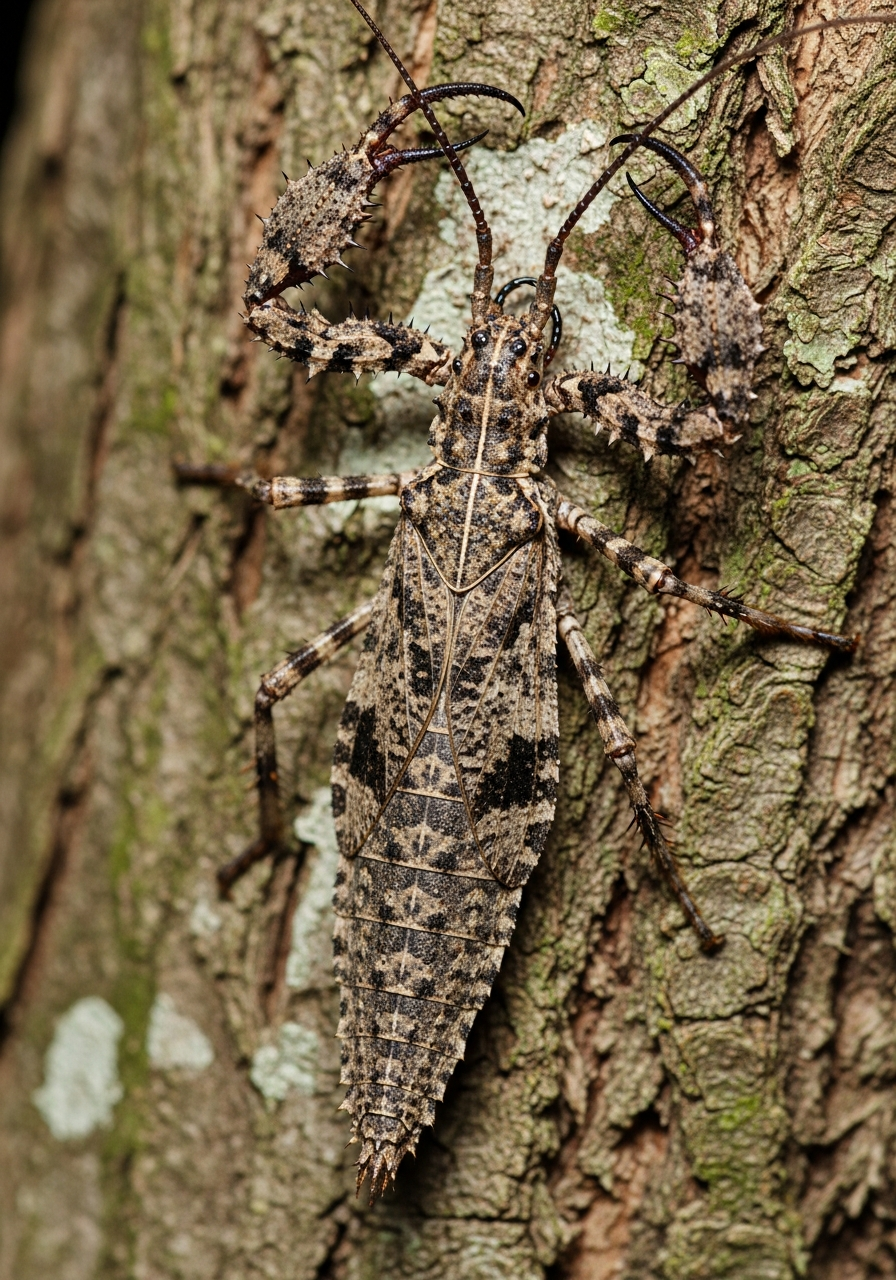
Amblyphasma crusta
Phasmapygi
Field Report Summary
Discovered clinging motionless to tree bark in the Amazonian rainforest, the Phasmapygi is a master of disguise, mimicking twigs and lichens. It ambushes small insects and even other arachnids with lightning-fast strikes from its formidable, spiny pedipalps, using its long, whip-like first legs as sensory probes in the darkness.
Physical Description
The Phasmapygi possesses an elongated, flattened body, typically 10-15 cm long, camouflaged in shades of brown, grey, and green, mimicking bark or lichen. It has six sturdy, jointed walking legs like an insect, but the first pair of legs is extremely thin, elongated, and whip-like, much longer than its body, covered in fine sensory hairs. The head features short, segmented antennae typical of an insect, but is dominated by two large, spiny, raptorial pedipalps, resembling those of a whip scorpion, used for grasping prey. Its exoskeleton is hard and textured, providing excellent crypsis.
Habitat
Humid tropical and subtropical forests, particularly Amazonian rainforest. It prefers to inhabit tree trunks, branches, and under loose bark.
Dietary Behavior
Carnivorous and predatory. It is an ambush hunter, patiently waiting for unsuspecting insects, small spiders, and even small geckos to pass within reach, which it then snatches with its powerful, spiny pedipalps.
Evolutionary Origin
Genetic analysis suggests the Phasmapygi evolved from an ancient lineage where insect and arachnid traits converged, possibly through a complex series of gene transfers or a highly unusual, parallel evolution in a specialized niche. This creature effectively bridges the morphological gap between the two arthropod classes, optimizing both camouflage and predatory efficiency.