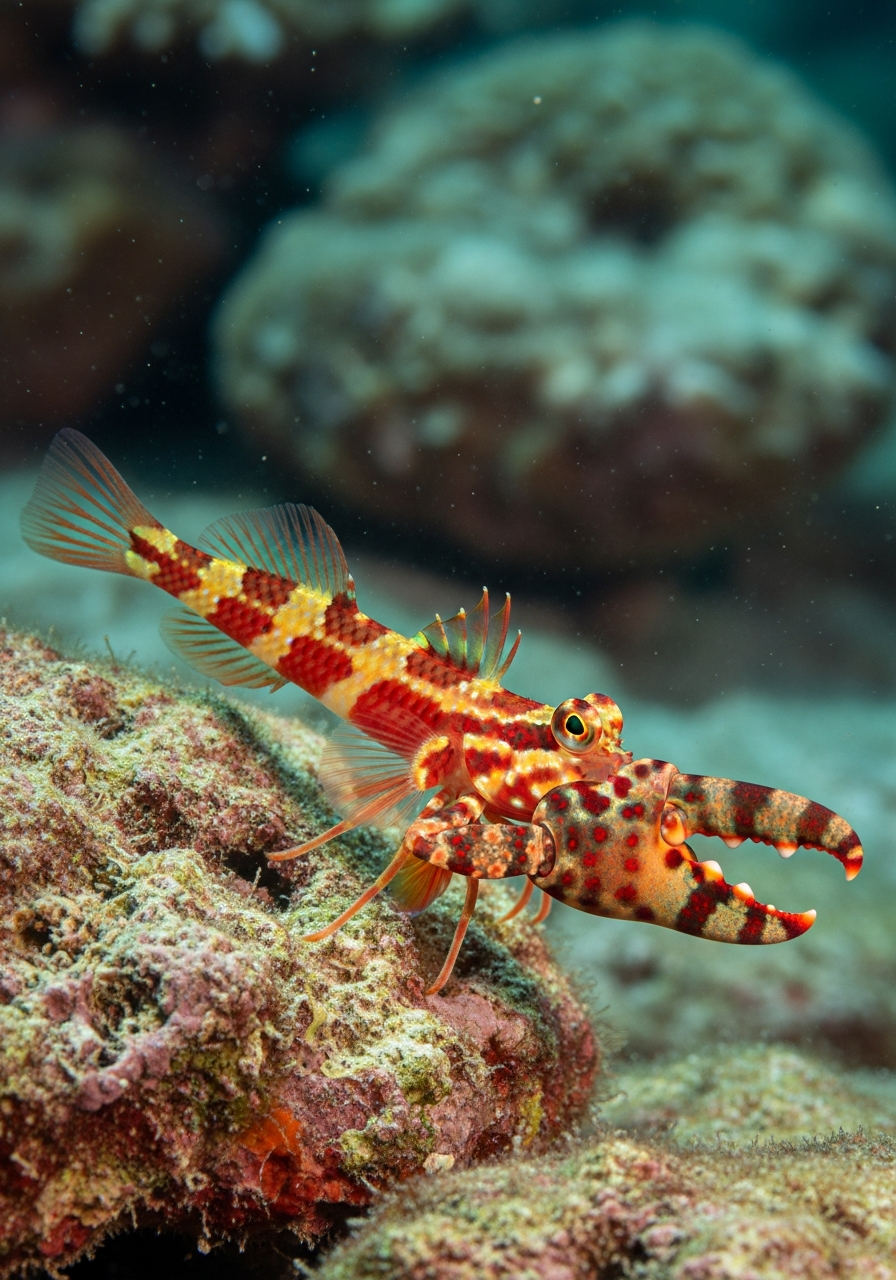
Scatpistolus draconis
Pistolscad
Field Report Summary
First observed in the coral reefs of the Philippines by marine biologist Dr. Anya Sharma, the Pistolscad displays a unique hunting strategy combining the camouflage of dragonets with the powerful claw of a pistol shrimp. Its discovery has prompted further research into the possibilities of inter-species genetic transfer in extreme marine environments. These creatures have been spotted communicating in complex patterns using sonic bursts.
Physical Description
The Pistolscad's body is elongated and slender, resembling a dragonet fish (specifically the Ruby Red Dragonet). It has vibrant red and yellow coloration, providing camouflage among coral. One of its claws has evolved into an oversized, heavily armored 'pistol' claw, capable of snapping shut with immense force. It possesses small, iridescent fins along its back and underside, and large, observant eyes.
Habitat
Coral reefs, specifically shallow waters with abundant coral and rocky outcroppings.
Dietary Behavior
Carnivorous; primarily feeds on small crustaceans and invertebrates. It uses its pistol claw to stun or kill prey before consuming it.
Evolutionary Origin
The Pistolscad is believed to have arisen due to a rare instance of horizontal gene transfer in a highly polluted marine environment, where mutagens caused the merging of genetic material between a dragonet and a pistol shrimp. This resulted in the expression of traits from both species within a single organism.