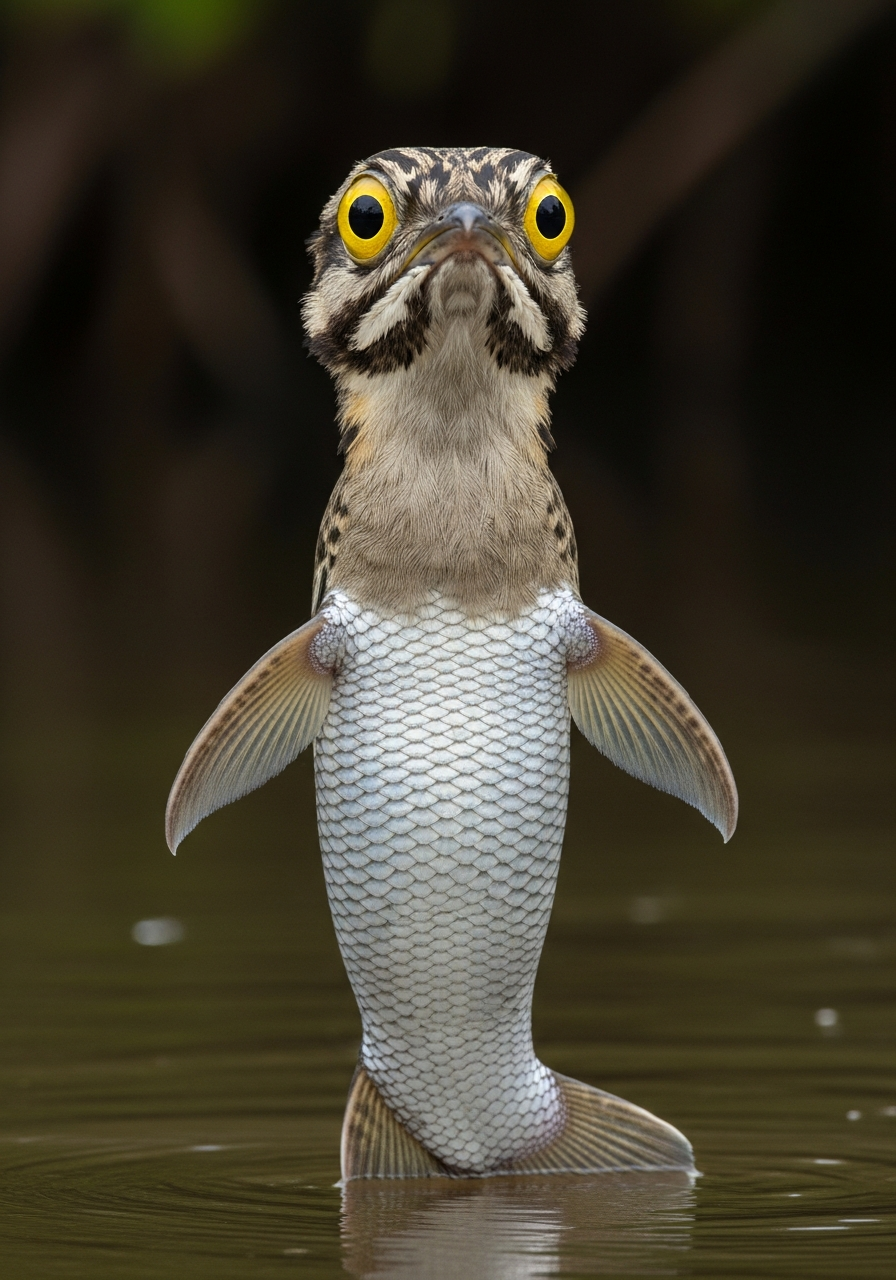
Noctupiscis compressus
Potohatchet
Field Report Summary
Discovered in the moonlit mangroves of the Sundarbans, the Potohatchet exhibits an eerie stillness, mimicking broken branches with its rigid, upright posture. It waits patiently for small prey to pass, its massive, Potoo-like gape snapping shut with surprising speed. Despite its avian-like upper body, its lower half is strikingly fish-like, allowing it to navigate shallow waters and muddy banks with ease, making it a master of amphibious ambush.
Physical Description
This creature stands approximately 40-50 cm tall, with the upper torso, head, and disproportionately large, yellow eyes remarkably similar to a Great Potoo: mottled grey-brown plumage provides excellent camouflage. Its lower body, however, is severely laterally compressed, silvery, and covered in fine, iridescent scales, tapering into a rudimentary caudal fin. Two small, membranous pectoral fins protrude from its sides, used for subtle propulsion in water and as stabilizers on land.
Habitat
Mangrove forests, freshwater swamps, and slow-moving muddy rivers in tropical regions.
Dietary Behavior
Primarily an ambush predator, it feeds on small fish, frogs, large insects, and crustaceans. It waits motionless, camouflaged amongst the vegetation, then lunges with its cavernous, Potoo-like mouth to capture unsuspecting prey.
Evolutionary Origin
Genetic analysis suggests the Potohatchet arose from an extraordinary fusion event between an ancestral Potoo species and a deep-bodied, estuarine hatchetfish, possibly facilitated by a unique retroviral vector or intense environmental pressures favoring a highly specialized amphibious predator. This resulted in a creature optimized for camouflaged ambush across the aquatic-terrestrial interface.