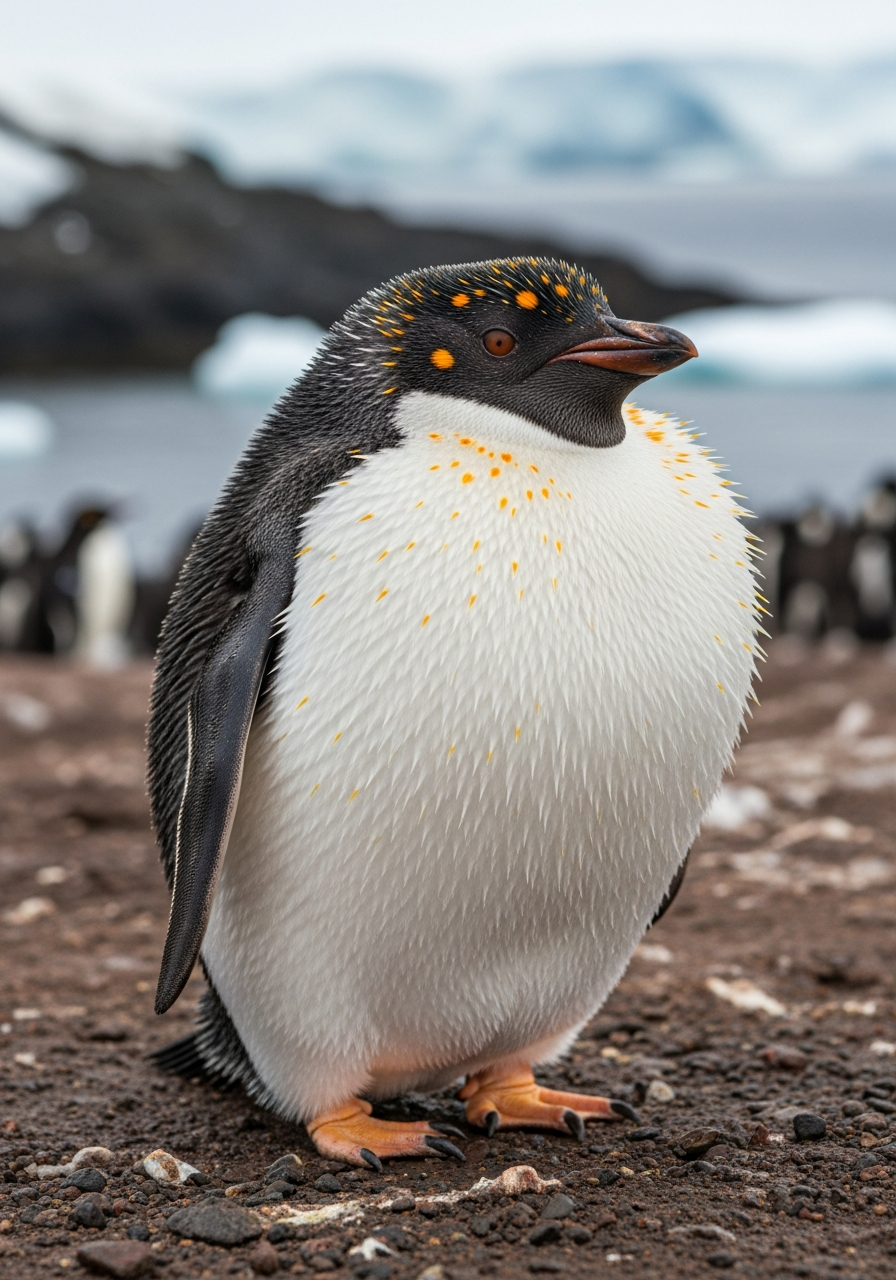
Globopten aptenodytes
Pufferguin
Field Report Summary
Discovered near a research station, these peculiar birds were initially mistaken for buoys. Their ability to triple in size when threatened is a unique defense mechanism among avian species.
Physical Description
The Pufferguin resembles a slightly larger than average penguin, roughly 3 feet tall. Its plumage is predominantly black and white, with vibrant orange and yellow spots that appear when inflated. The beak is short and stout, adapted for crushing small crustaceans and fish. Its most striking feature is the ability to inflate to nearly twice its normal size, displaying rows of small, non-toxic spines.
Habitat
Rocky coastlines and icy waters of the Antarctic and sub-Antarctic regions. They often congregate in large colonies, both on land for breeding and in the water for foraging.
Dietary Behavior
Feeds on krill, small fish, and hard-shelled crustaceans using its beak. Inflates to deter Leopard Seals.
Evolutionary Origin
A rapid adaptation of King Penguins to increased predation, activating dormant genes shared with ancient puffers.
Behavioral Notes
Waddles clumsily on land but is surprisingly buoyant in water. Males inflate to impress females during mating season.