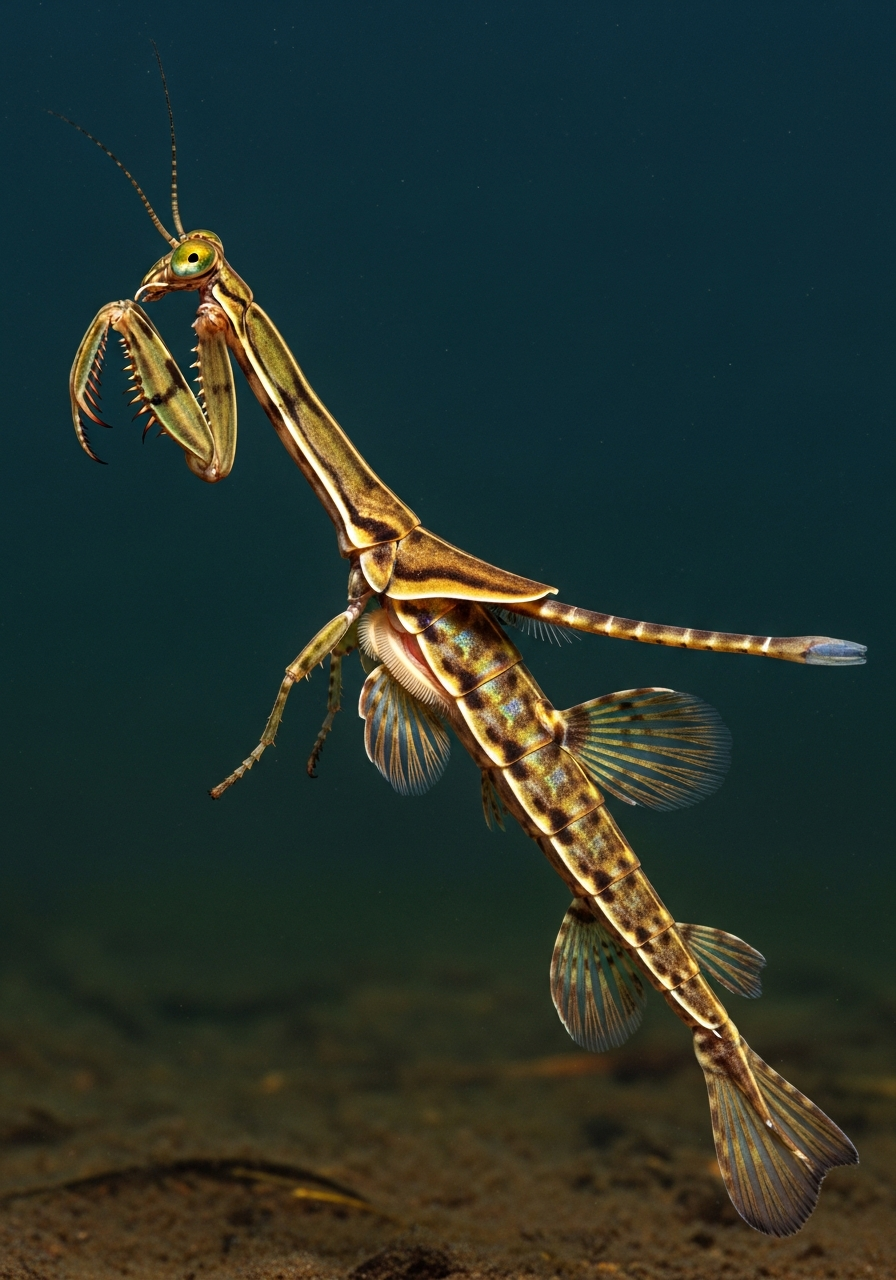
Hydronepa sagittans
Ranatrox
Field Report Summary
Discovered in the slow-moving rivers of Southeast Asia, the Ranatrox is a master of ambush predation, lurking amidst aquatic vegetation with its breathing siphon barely breaking the surface. Its unique ability to launch precise jets of water allows it to dislodge and stun unsuspecting terrestrial insects from overhanging branches, which it then swiftly captures with its powerful, modified forelegs. This complex feeding strategy highlights a novel evolutionary pathway for exploiting both aquatic and semi-aquatic prey.
Physical Description
Possessing a long, flattened, and highly camouflaged body that mimics submerged detritus, the Ranatrox measures approximately 15-20 cm in length. Its most striking features include a pair of powerful, spiny raptorial forelegs, reminiscent of a praying mantis but adapted for aquatic grip, and a fully articulated, fanned caudal fin for propulsion. A long, slender breathing siphon extends from its posterior, allowing it to remain submerged, while its large, forward-facing eyes are acutely adapted for both underwater vision and detecting movement above the surface for target acquisition. Along its dorsal surface, subtle, iridescent scales shimmer, typical of certain fish species, contrasting with the otherwise muted brown and green chitinous exoskeleton. Gills are subtly visible under a protective operculum-like structure near its mid-section, complementing its tracheal breathing system.
Habitat
Slow-moving freshwater rivers, ponds, and wetlands in tropical and subtropical regions, particularly those with abundant overhanging vegetation.
Dietary Behavior
An opportunistic carnivore, the Ranatrox primarily preys on terrestrial insects (like grasshoppers, beetles, and small moths) that it dislodges from branches by shooting powerful jets of water. It also consumes smaller aquatic insects, tadpoles, and juvenile fish, which it ambushes and seizes with its raptorial forelegs.
Evolutionary Origin
Genetic analysis suggests the Ranatrox emerged from a rare, ancient inter-kingdom hybridization event between a lineage of Nepidae (water scorpions) and early Toxotidae (archerfish) during a period of significant environmental flux in ancient Southeast Asia. This unique genetic fusion likely allowed the hybrid offspring to rapidly adapt to a niche requiring both aquatic camouflage and a novel method for securing terrestrial prey, preserving traits from both parent groups.